Knowledge base · Sweeteners
Sweeteners — sugars, non-sugar sweeteners, and sugar alcohols
A sweetener is any substance added to food to give a sweet taste. This is NakedCalorie's reference to the four sweetener families that dominate the modern food label — added sugars, high-intensity non-sugar sweeteners, plant-derived extracts, and sugar alcohols — with regulatory status, evidence, and how each family lands in the food-quality score.
What is a sweetener?
A sweetener is any food ingredient whose primary technological function is to deliver sweet taste. The category spans caloric carbohydrates that have been part of the human diet for millennia, plant-derived molecules purified into gram-per-kilogram intensity, and synthetic molecules with no natural analogue.
Food regulators split the category by intent, not by chemistry. The US FDA distinguishes nutritive sweeteners (sucrose, glucose, fructose, honey, maple syrup, HFCS, sugar alcohols) from non-nutritive sweeteners (aspartame, sucralose, saccharin, acesulfame-K, steviol glycosides, monk fruit extract, neotame, advantame). The EU uses the same functional split but codes every non-sugar sweetener with an E-number under Regulation (EC) No 1333/2008 and requires a specific labelling statement — "with sweetener(s)" or "with sugar and sweetener(s)."
The reason the category matters as a category, not as isolated molecules, is that sweeteners share a demand profile: they exist because consumers reward sweetness. Every sweetener that reaches supermarket scale — from cane sugar to reb M — is a supply-side answer to that demand. The health question is which combination of price, calories, glycemic effect, and long-term evidence you accept.
The four sweetener families
Every sweetener on a US or EU label belongs to one of four families: added sugars, high-intensity non-sugar sweeteners, plant-derived extracts, and sugar alcohols (polyols). The families differ in energy density, glycemic effect, regulatory framework, and how NOVA classifies their use.
- Added sugars. Sucrose, glucose, fructose, dextrose, maltose, high-fructose corn syrup, invert sugar, honey, maple syrup, agave syrup, cane juice, rice syrup, and dozens of other named sugars. All are mono- or disaccharides, all deliver ~4 kcal/g, all raise blood glucose (fructose indirectly via hepatic metabolism). Regulated as food ingredients, not additives. See high-fructose corn syrup and added sugar.
- High-intensity non-sugar sweeteners. Aspartame, sucralose, saccharin, acesulfame-K, neotame, advantame, cyclamate. Synthetic molecules 200–20,000× sweeter than sucrose. Regulated as food additives with defined Acceptable Daily Intakes. See aspartame, sucralose, acesulfame-K, and saccharin.
- Plant-derived high-intensity sweeteners. Steviol glycosides (from Stevia rebaudiana), mogrosides (from monk fruit, Siraitia grosvenorii), thaumatin (from katemfe fruit), brazzein. Also 200–300× sweetness. Regulated as additives despite plant origin. See stevia and monk fruit.
- Sugar alcohols (polyols). Erythritol, xylitol, sorbitol, mannitol, maltitol, isomalt, lactitol, allulose (technically a rare sugar, not a polyol, but regulated similarly in the US). Bulk sweeteners with reduced glycemic impact and calories. Listed separately on the US Nutrition Facts panel. See sugar alcohols, erythritol, xylitol, and allulose.
Sweetness intensity, ADIs, and everyday exposure
Sweetness is measured relative to a 10% sucrose solution. The high-intensity sweeteners deliver perceived sweetness in the mg-per-serving range, which is why a diet cola contains ~180 mg aspartame but a regular cola contains ~39 g sucrose — a mass difference of ~200×.
| Sweetener | Sweetness (× sucrose) | Energy (kcal/g) | ADI (mg/kg bw/day) | Regulator |
|---|---|---|---|---|
| Sucrose | 1× | 4 | — | Food ingredient |
| HFCS-55 | ~1× | 4 | — | Food ingredient |
| Aspartame (E951) | 200× | 4 (but negligible per serving) | 40 EFSA / 50 FDA | Additive |
| Sucralose (E955) | 600× | 0 | 15 EFSA / 5 FDA | Additive |
| Saccharin (E954) | 300× | 0 | 5 | Additive |
| Acesulfame-K (E950) | 200× | 0 | 9 EFSA / 15 FDA | Additive |
| Steviol glycosides (E960) | 200–350× | 0 | 4 | Additive |
| Mogrosides (monk fruit) | 150–200× | 0 | Not specified | US GRAS · not EU-approved |
| Erythritol (E968) | 0.6× | 0.2 | Not specified | Polyol |
| Xylitol (E967) | 1× | 2.4 | Not specified | Polyol |
| Allulose | 0.7× | 0.4 | Not specified | US rare-sugar · not EU-approved |
The ADI framework was designed for food additives, so bulk sweeteners like sucrose and the polyols have none. That is not a safety statement — it means the toxicological programme that produced ADIs was aimed at low-dose molecules with narrow uses, not carbohydrates consumed in gram quantities. Sugar alcohols instead carry a European labelling requirement ("excessive consumption may produce laxative effects") triggered by loose-stool thresholds observed in feeding studies.
The 2023 WHO guideline on non-sugar sweeteners
In May 2023 the World Health Organization released a conditional recommendation against the use of non-sugar sweeteners for weight control. The guideline was based on a systematic review by Rios-Leyvraz & Montez covering 283 studies including 50 RCTs and 97 prospective cohorts.
The core findings: pooled RCTs showed a modest short-term reduction in body weight and BMI when non-sugar sweeteners replaced sugar. Pooled prospective cohorts showed the opposite direction — higher non-sugar-sweetener intake was associated with higher body weight (BMI +0.14 per additional serving/day), higher type-2 diabetes incidence (RR 1.23), higher cardiovascular disease mortality (RR 1.19), and higher all-cause mortality (RR 1.12). WHO's interpretation was that RCTs capture the substitution effect while cohorts capture the long-term dietary pattern, and that the pattern signal outweighs the short-term substitution benefit.
The FDA and EFSA did not change their approvals in response. JECFA (the WHO/FAO joint expert committee on food additives) reviewed aspartame two months later and reaffirmed its ADI. The result is a coexisting-guidance landscape: additive approvals rest on toxicology; dietary guidance rests on outcomes.
Aspartame and the July 2023 IARC Group 2B decision
The International Agency for Research on Cancer classified aspartame as "possibly carcinogenic to humans" (Group 2B) on 14 July 2023, based on limited evidence for hepatocellular carcinoma in humans and limited evidence in experimental animals. On the same day JECFA reaffirmed the acceptable daily intake at 40 mg/kg body weight per day.
Group 2B is the same tier as aloe vera whole-leaf extract, ginkgo biloba extract, and pickled vegetables. It captures agents where the evidence is not sufficient to move them into Group 2A ("probably carcinogenic") or Group 1 ("carcinogenic to humans"). The IARC review was hazard identification: does this agent have the capacity to cause cancer under any exposure? JECFA's review was risk assessment: does typical human exposure exceed a safe intake?
NakedCalorie surfaces aspartame with the current IARC/JECFA status on the individual entry. It is not treated as unsafe — the FDA, EFSA, and JECFA continue to approve it — but it is not treated as inert. See aspartame for the full evidence log.
Sugar alcohols and the Witkowski cardiovascular signals
Sugar alcohols were long regarded as metabolically inert — reduced calories, negligible glycemic effect, dental non-cariogenicity. Two Nature Medicine papers in 2023 and 2024 reopened the question for erythritol and xylitol specifically.
Witkowski et al. (Nature Medicine, February 2023) reported that circulating erythritol was associated with major adverse cardiovascular events (MACE) at 3-year follow-up in three cohorts totalling ~4,000 patients. In an interventional arm, eight healthy volunteers ingested 30 g erythritol — the amount in a keto-labelled dessert serving — and showed elevated platelet reactivity for 2–3 days. Witkowski et al. (Nature Medicine, August 2024) reported the same pattern for xylitol: association with MACE in ~3,300 patients and platelet activation after a 30 g oral dose.
Both signals are observational plus mechanistic; neither is a randomised outcome trial. Endogenous erythritol production from glucose via the pentose phosphate pathway confounds the association direction. The EFSA reviewed the evidence in September 2023 and did not restrict use. NakedCalorie flags erythritol and xylitol with the current evidence but does not remove them from the polyol category. See erythritol and xylitol.
Added sugar and the WHO free-sugar cap
The 2015 WHO Guideline: Sugars intake for adults and children recommends limiting free sugars to less than 10% of total energy intake (strong recommendation) with a conditional further reduction to below 5%. Free sugars include all mono- and disaccharides added to foods plus sugars naturally present in honey, syrups, fruit juices, and fruit-juice concentrates.
The Malik et al. 2022 Nature Reviews Endocrinology meta-analysis pooled prospective evidence on sugar-sweetened beverage intake: each additional serving/day was associated with a 27% higher risk of type-2 diabetes (13 cohorts) and an 8% higher risk of cardiovascular disease (10 cohorts). The US 2016 Nutrition Facts revision added a mandatory Added Sugars line and a %DV based on a 50 g reference intake (10% of a 2,000 kcal diet). The 2019–2020 NHANES cycle put mean US added-sugar intake at 68 g/day — 14% of energy on average, roughly 40% above the WHO cap.
NakedCalorie's added-sugar penalty is calibrated to the WHO thresholds, per serving. See added sugar for the full methodology.
US vs EU regulatory status
The US uses a mixed GRAS/food-additive framework where sweeteners can enter the market either via an FDA food-additive approval or via manufacturer self-affirmed GRAS. The EU requires positive pre-market approval by EFSA for every non-sugar sweetener under Regulation (EC) No 1333/2008 and re-evaluates them on a rolling schedule.
| Sweetener | US status | EU status | Last major review |
|---|---|---|---|
| Aspartame | Approved 1981 | Approved; EFSA 2013 kept ADI 40 | IARC 2B + JECFA 2023 |
| Sucralose | Approved 1998 | Approved 2004 | EFSA re-evaluation ongoing |
| Acesulfame-K | Approved 1988 | Approved | EFSA re-evaluation 2023–2024 |
| Saccharin | Approved; NTP warning removed 2000 | Approved | — |
| Steviol glycosides | GRAS from 2008 | Approved 2011; reb M added 2019 | EFSA 2020 |
| Monk fruit (mogrosides) | GRAS from 2010 | Not approved | EFSA scientific opinion 2019 |
| Erythritol | GRAS from 2001 | E968, approved 2006 | EFSA 2023 (post-Witkowski) |
| Xylitol | Approved as sweetener & nutritive additive | E967, approved | — |
| Allulose | Excluded from Total & Added Sugars 2019 (FDA labeling) | Not approved | Novel-food application pending |
How does NakedCalorie score sweeteners?
Sweeteners enter the food-quality score through three channels: the NOVA classifier, the added-sugar penalty, and the additive-load tally.
- NOVA trigger. Any non-sugar sweetener on the ingredient list — including stevia and monk fruit — moves the product to NOVA Group 4 by the Monteiro 2019 markers. This is the same rule NakedCalorie applies for any high-intensity sweetener regardless of botanical origin.
- Added-sugar penalty. Per-serving added sugar is scored against WHO thresholds. A single 12 oz sugar-sweetened beverage delivers ~39 g added sugar — 78% of the US %DV — and takes the maximum penalty. Sugars naturally present in intact fruit or milk are exempt.
- Additive-load tally. Each distinct sweetener adds to the additive count. Sugar alcohols count once as a class. Products blending three or more sweeteners (common in "sugar-free" desserts) score worse than single-sweetener formulations.
The score is deliberately conservative: it never marks a sweetener unsafe, because "unsafe" is a regulator's determination. It marks products as more or less formulated around sweetness, and lets users decide their own line. See What's Inside for the full methodology.
Browse every article in this hub
Aspartame
The sweetener behind most diet sodas. What it is, its 2023 IARC classification, and how regulators currently treat it.
8 min read
Sucralose
A chlorinated sugar molecule the body doesn't metabolize. What the human evidence actually shows on gut health, glucose response, and safety.
7 min read
High-fructose corn syrup (HFCS)
The industrial sweetener behind most sweetened drinks in the US. What it is, how it differs from sugar, and what the evidence says.
7 min read
Stevia (steviol glycosides)
The plant-derived non-sugar sweetener with a modern regulatory footprint — and why NOVA still flags the purified extract as ultra-processed.
7 min read
Monk fruit (mogrosides)
The other 'natural' non-sugar sweetener — same NOVA Group 4 status, different regulatory footprint on either side of the Atlantic.
6 min read
Sugar alcohols (polyols)
The bulk sweeteners behind sugar-free gum, low-carb baked goods, and 'no sugar added' ice cream — and their honest GI trade-off.
8 min read
Acesulfame potassium (Ace-K, E950)
The heat-stable synthetic sweetener behind most 'zero' beverages — usually blended with sucralose to hide the finish.
6 min read
Saccharin (E954)
The oldest artificial sweetener, cleared of its cancer warning in 2000 — and still a workhorse in tabletop sachets and drug formulations.
6 min read

Allulose (D-psicose)
The 'rare sugar' that tastes and behaves like sucrose in baking, is nearly calorie-free, but is legal in the US and not in the EU.
7 min read
Erythritol (E968)
The workhorse bulk sweetener behind stevia, monk fruit, and keto baking — and the subject of a 2023 Nature Medicine cardiovascular signal that regulators are still weighing.
7 min read
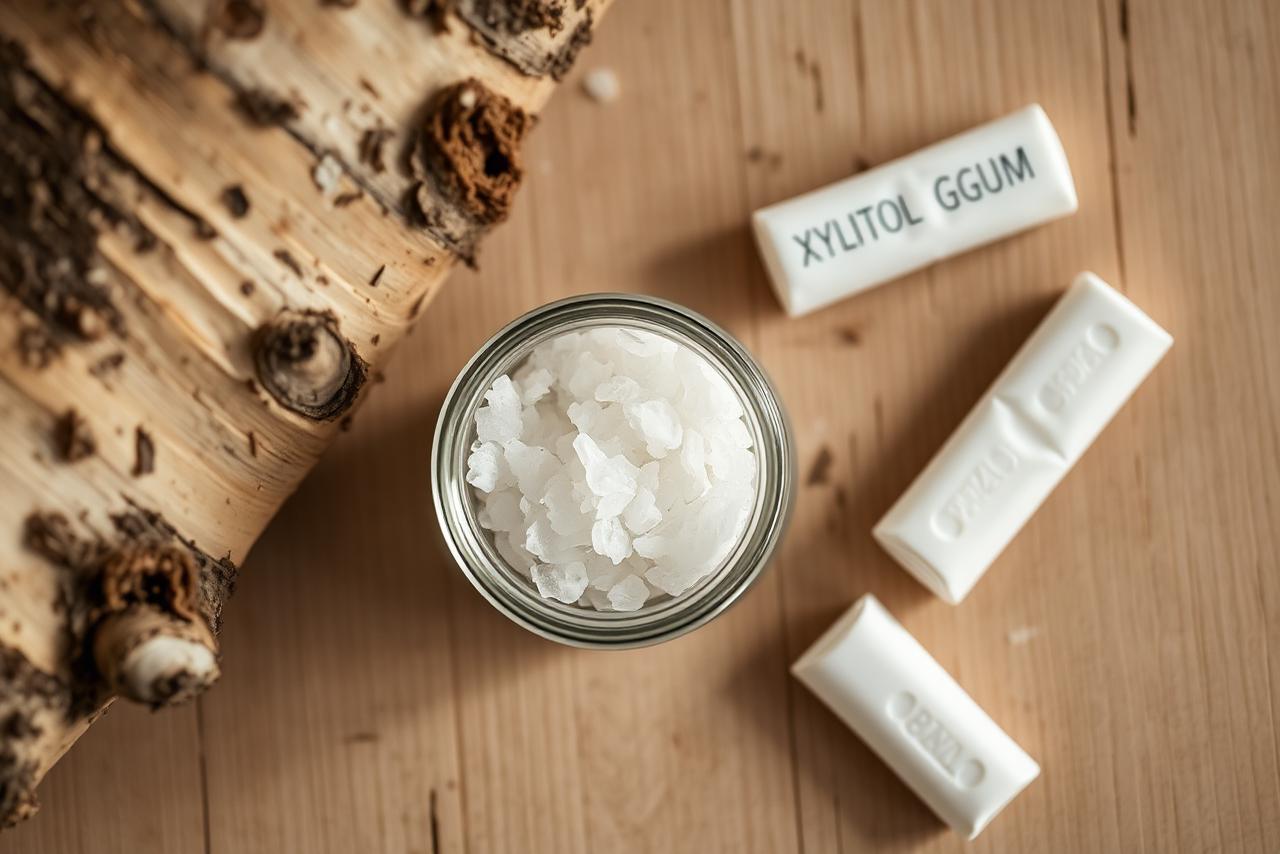
Xylitol (E967)
The dental-caries-cutting polyol behind sugar-free gum — with a real cardiovascular signal on the 2024 evidence and a genuine risk to dogs.
7 min read
Frequently asked questions
- Are non-sugar sweeteners safer than sugar?
- The 2023 WHO guideline recommends against using non-sugar sweeteners for weight control, citing observational associations with type-2 diabetes and cardiovascular outcomes and no consistent long-term benefit for weight loss. Regulators (FDA, EFSA, JECFA) continue to classify approved sweeteners as safe at typical intakes. The two positions coexist: acute toxicity is low, but 'a permanent substitute for sugar' is not what the evidence supports.
- What is the difference between a sweetener and a sugar?
- A sugar is a specific class of carbohydrate — monosaccharide or disaccharide — that provides ~4 kcal/g. A sweetener is anything used to sweeten food, sugar or otherwise. All sugars are sweeteners; most sweeteners on modern industrial labels are not sugars.
- Do sugar alcohols count as added sugar?
- No. On the US Nutrition Facts panel sugar alcohols are listed separately from Total Sugars and Added Sugars because polyols are not sugars. They still contribute calories (0.2–3 kcal/g depending on the polyol) and can cause laxation and gastrointestinal symptoms at higher doses. Erythritol is unusual: it is nearly zero-calorie because it is absorbed in the small intestine and excreted intact in urine.
- How does NakedCalorie score sweeteners?
- Any non-sugar sweetener triggers NOVA Group 4 by the Monteiro 2019 rule, so its presence lowers the score. Added sugars are scored separately against per-serving thresholds informed by the WHO free-sugar guideline (≤10% of energy, ideally ≤5%). Sugar alcohols add to the additive count but do not trigger the added-sugar penalty.
- Is stevia 'natural' and therefore safe?
- The stevia leaf is a plant. The sweetener sold as 'stevia' is steviol glycosides — purified extracts (rebaudioside A, stevioside, reb M) produced in a multi-step chemical or fermentation process. EFSA and FDA both approve them; NOVA classifies them as ultra-processed additives regardless of botanical origin.
- Why is high-fructose corn syrup singled out when it's chemically similar to sucrose?
- HFCS-55 is ~55% fructose, sucrose is 50% fructose after hydrolysis — the difference is small. What is not small is the delivery format. HFCS is cheap, liquid, and ubiquitous in industrial beverages and condiments, driving up total added-sugar intake at the population level. The Malik 2022 meta-analysis links sugar-sweetened beverage intake specifically — not fruit sugar — to type-2 diabetes and cardiovascular disease.
- What is the erythritol cardiovascular signal from 2023?
- Witkowski et al. (Nature Medicine, February 2023) reported that circulating erythritol was associated with major adverse cardiovascular events in three cohorts totalling ~4,000 patients, and that ingesting 30 g erythritol raised platelet reactivity in healthy volunteers for 2–3 days. A 2024 follow-up (Nature Medicine, August 2024) reported a similar pattern for xylitol. Both signals are observational and need RCT confirmation, but they are why NakedCalorie no longer treats sugar alcohols as strictly inert.
- Is aspartame a carcinogen?
- In July 2023 the IARC classified aspartame as 'possibly carcinogenic to humans' (Group 2B) — the same tier as aloe vera extract and pickled vegetables. The JECFA reviewed the same evidence and reaffirmed the existing acceptable daily intake of 40 mg/kg body weight per day. The IARC classification is a hazard identification (can it cause cancer under some exposure?), not a risk assessment (does it at typical intakes?).
Continue in the knowledge base