
Stevia (steviol glycosides)
Stevia is the common name for steviol glycosides — sweet diterpene compounds extracted and purified from Stevia rebaudiana leaves. FDA GRAS since 2008 for ≥95% purity; EFSA E960, ADI 4 mg/kg body weight per day. 200–350× sweeter than sucrose, essentially zero calories, and classified NOVA Group 4 as a non-sugar sweetener.
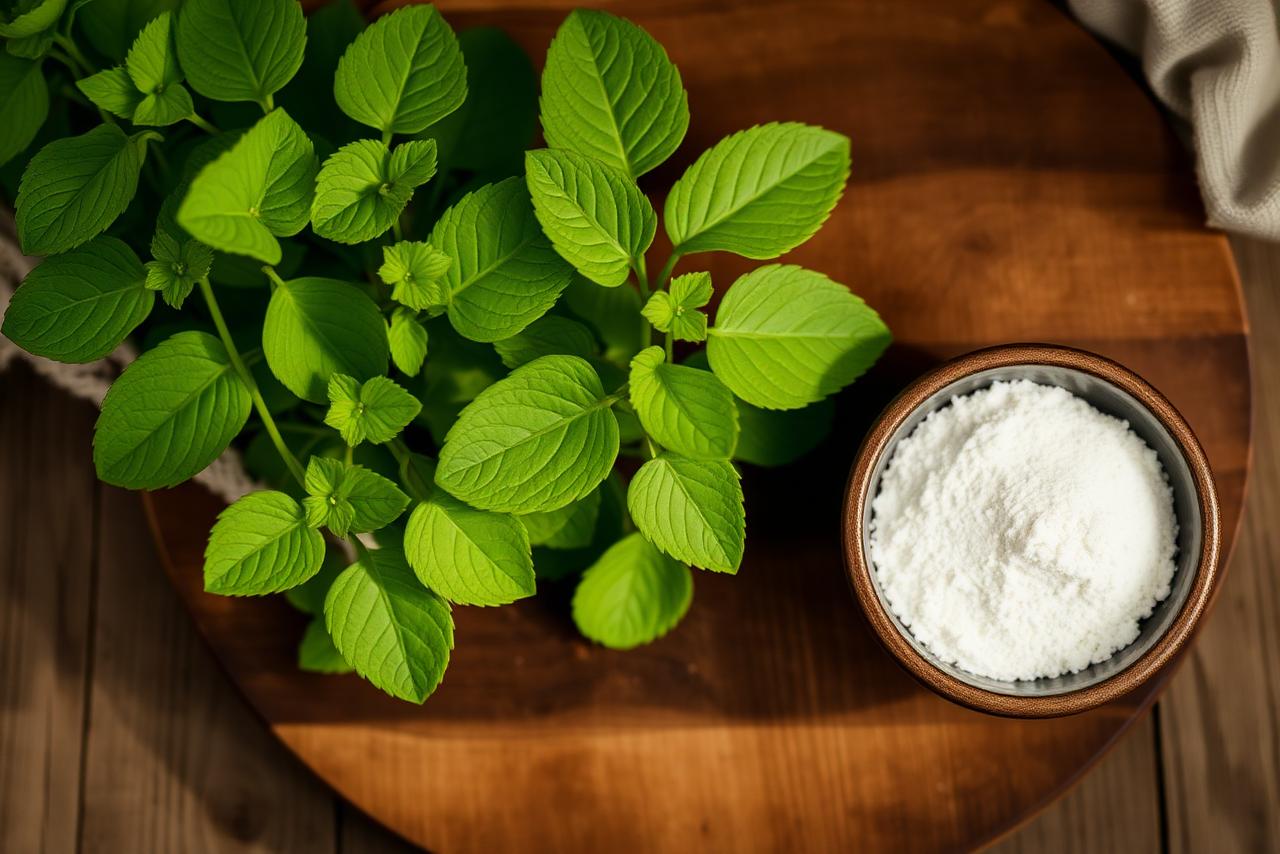
What stevia actually is
Stevia is the common name for a family of sweet-tasting diterpene glycosides — collectively "steviol glycosides" — extracted from the leaves of the South American shrub Stevia rebaudiana Bertoni. The eleven known glycosides share a common steviol backbone; commercial products are dominated by rebaudioside A, rebaudioside M, and stevioside. Extraction uses hot-water infusion followed by clarification, filtration, and ion-exchange or crystallisation to isolate specific glycosides. The end product is a white powder that is 200–350 times sweeter than sucrose.
Regulatory position
| Body | Status | ADI |
|---|---|---|
| FDA (US) | GRAS since 2008 for ≥95% purity | 4 mg/kg (steviol equivalents) |
| EFSA (EU) | E960, approved 2011 | 4 mg/kg |
| JECFA (WHO/FAO) | "Not of safety concern" | 4 mg/kg |
Whole-leaf stevia and crude extracts are not GRAS in the US — only high-purity steviol glycosides are approved.
Metabolism and blood glucose
Steviol glycosides pass through the small intestine intact; colonic bacteria hydrolyse them to free steviol, which is absorbed and rapidly glucuronidated in the liver before urinary excretion (Wheeler, Food and Chemical Toxicology 2008;46 Suppl 7:S54–S60). No component enters the glycolytic or gluconeogenic pathways, which is why acute glycaemic and insulinaemic responses are indistinguishable from water in controlled trials.
Where you'll find it
- Zero-sugar sodas and flavoured waters (often blended with erythritol or monk fruit).
- "Naturally sweetened" yoghurts, granolas, and protein bars.
- Tabletop sachets, usually bulked with erythritol or maltodextrin.
- Sugar-free syrups and coffee-shop bases.
The WHO 2023 non-sugar sweetener guideline
The WHO's conditional recommendation against non-sugar sweeteners for long-term weight control (WHO, Use of non-sugar sweeteners: WHO guideline, 2023) covers stevia alongside aspartame, sucralose, and acesulfame-K. It cites observational associations with type-2 diabetes and cardiovascular disease and does not prohibit use — the certainty of evidence is graded low. It explicitly does not apply to people with pre-existing diabetes, for whom short-term glycaemic substitution remains beneficial.
How NakedCalorie flags stevia
Stevia is a non-sugar sweetener and therefore triggers NOVA Group 4 classification by the Monteiro 2019 rule — the same as aspartame or sucralose. The scan surfaces steviol glycosides as an additive and adds them to the cosmetic-additive count. See monk fruit for the closest natural comparator, aspartame for the leading synthetic, and how to spot ultra-processed food for the wider ingredient logic.
Frequently asked questions
- Is stevia natural?
- The stevia leaf is a plant. What is sold as 'stevia' is a purified extract — usually rebaudioside A or M — produced by hot-water infusion, clarification, and ion-exchange or crystallisation. EFSA and FDA regulate it as a non-sugar sweetener; NOVA classifies the extract as ultra-processed regardless of botanical origin.
- What is the ADI for steviol glycosides?
- EFSA sets 4 mg/kg body weight per day, expressed as steviol equivalents. For a 70 kg adult that is about 280 mg/day — the FDA and JECFA use the same figure. Typical beverage and tabletop use sits well below this.
- Does stevia raise blood glucose?
- No. Steviol glycosides are not metabolised for energy: intestinal bacteria hydrolyse them to steviol, which is absorbed, glucuronidated in the liver, and excreted in urine. Controlled trials show no acute effect on glucose or insulin (Anton, Appetite 2010;55:37–43).
- Why the bitter aftertaste?
- Stevioside, one of the major glycosides in whole-leaf extract, binds bitter-taste receptors (TAS2R4, TAS2R14) alongside the sweet receptor. Newer preparations enriched in rebaudioside A or M — the pathway commercial products call out as 'Reb M' — have cleaner profiles.
- What does the WHO 2023 non-sugar sweetener guideline say about stevia?
- The WHO 2023 conditional recommendation advises against using non-sugar sweeteners (including stevia) for long-term weight control in the general population, citing observational associations with type 2 diabetes and cardiovascular disease. The evidence is graded low-certainty and the guideline does not prohibit use — it explicitly does not apply to people with pre-existing diabetes.
Written by NakedCalorie editorial team.
Medically reviewed by Pending registered dietitian review — last reviewed July 15, 2026.
Educational information only, based on peer-reviewed literature and regulatory sources. Not medical advice.
Related in the knowledge base
- SweetenersMonk fruit (mogrosides)
- SweetenersAspartame
- SweetenersSugar alcohols (polyols)