
How to spot ultra-processed food at a glance
You can identify an ultra-processed food in about ten seconds by scanning the ingredient list for one of five tell-tale markers: cosmetic additives, industrial ingredients not used in home kitchens, protein isolates, modified starches, or non-sugar sweeteners. Any single marker moves a product into NOVA Group 4.
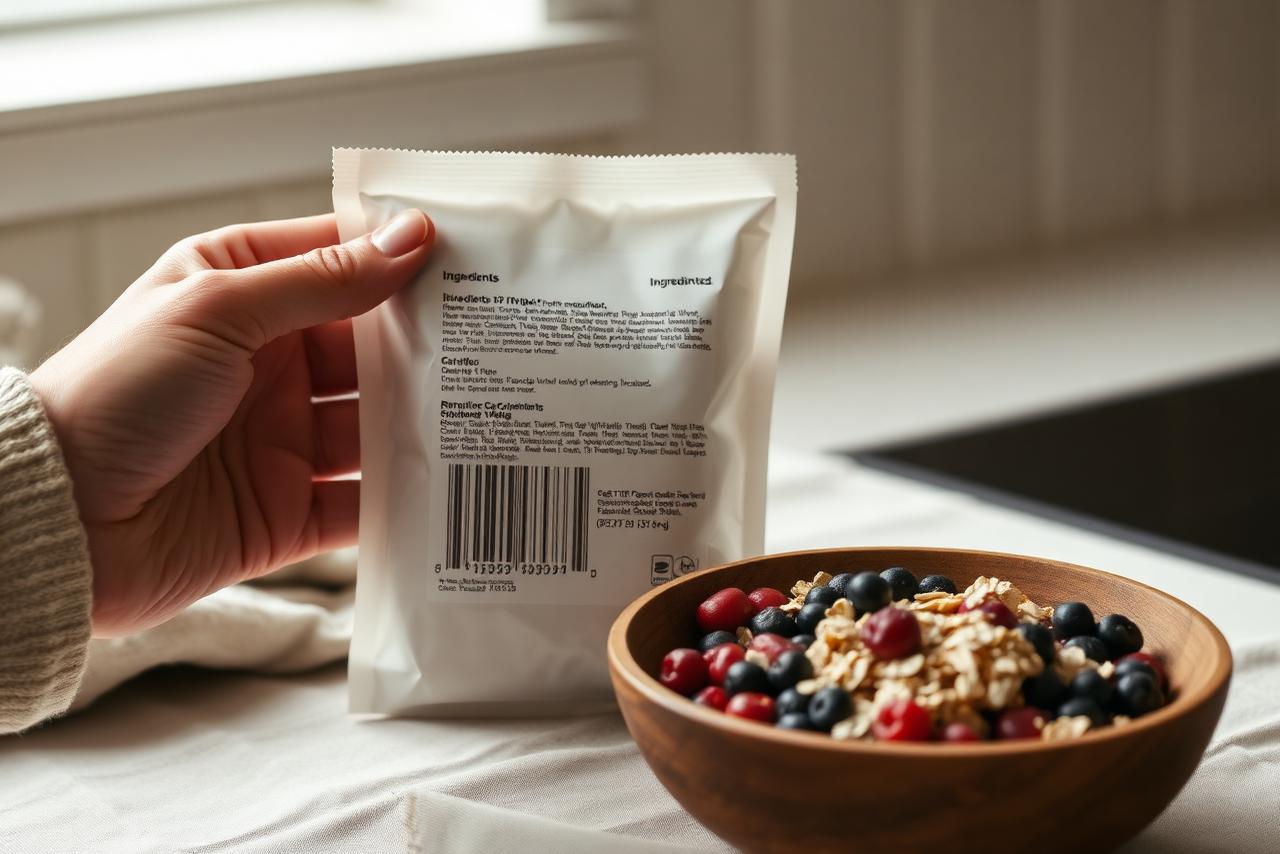
The ten-second field test
Flip the product over and read the ingredient list. If you see any of the five markers below, it is ultra-processed under NOVA Group 4. If you see none of them, it is probably Group 1, 2, or 3.
- Cosmetic additives. Colours, flavours (including "natural flavour"), emulsifiers, thickeners, non-sugar sweeteners, and gloss agents. See the additives reference.
- Industrial ingredients not used in home kitchens. Hydrogenated or interesterified oils, invert sugar, high-fructose corn syrup, maltodextrin, dextrose, glucose–fructose syrup.
- Protein isolates and hydrolysates. Whey protein isolate, soy protein isolate, hydrolysed vegetable protein, pea protein isolate.
- Modified starches. Modified corn starch, modified tapioca starch, resistant maltodextrin.
- Non-sugar sweeteners. Aspartame, sucralose, acesulfame-K, saccharin, steviol glycosides, monk fruit extract.
These markers come from the decision rule Monteiro's team published in Public Health Nutrition in 2019 and reaffirmed in the PAHO/FAO NOVA reference documents. A single marker is sufficient; there is no threshold count.
Why the marker test works
NOVA groups foods by the purpose of the processing, not the quantity. The five markers above only appear in products that have been reformulated for industrial-scale palatability, shelf life, and cost — the definition of Group 4. Home cooks do not use protein isolates, hydrogenated oils, or non-sugar sweeteners; food scientists do. That is why a single marker is decisive.
Front-of-pack signals that also predict Group 4
You can often skip the ingredient list entirely. Any of the following on the front of a package makes Group 4 status close to certain:
- Health claim such as "high protein", "high fibre", "fortified", or "with added vitamins".
- "Diet", "light", "zero sugar", or "no added sugar" (typically implies non-sugar sweeteners).
- Fun-shaped or animated pack aimed at children.
- Shelf life longer than a few weeks at ambient temperature (bread, dairy, cured meat).
- Marketed as a "meal replacement", "protein bar", or "snack".
Foods that look processed but usually aren't Group 4
- Canned beans and tomatoes in water/brine. Group 1 or 3 depending on added salt.
- Frozen vegetables and fruit. Group 1.
- Plain cheeses, butter, and traditionally cured meats. Group 3.
- Dried pasta made only from flour and water. Group 3.
- Wine, beer, and unsweetened yoghurt. Group 3.
How NakedCalorie automates the test
The app tokenises every ingredient string, maps each token to a knowledge-base entry, and applies the five-marker rule automatically. A product's NOVA group appears on the scan result alongside the calorie count and the list of Group 4 markers detected. For the underlying framework see the NOVA hub, and for what the research says about Group 4 intake see the ultra-processed overview.
Frequently asked questions
- Is one industrial-sounding ingredient enough to make a food ultra-processed?
- Under the Monteiro 2019 decision rule, yes. The presence of a single cosmetic additive (colour, flavour, emulsifier, non-sugar sweetener) or a single industrial ingredient (protein isolate, invert sugar, modified starch, hydrogenated oil) moves the product into NOVA Group 4 — regardless of the nutrition panel.
- Do 'natural flavour' and 'natural colour' count as cosmetic additives?
- Yes. NOVA classifies flavourings and colourings by their function (making an industrial formulation palatable and visually appealing), not by whether their source is labelled natural. A juice with 'natural flavour' added is Group 4; freshly-squeezed juice with nothing added is Group 1.
- What about wholemeal bread or plain yoghurt with additives?
- If the bread contains only flour, water, salt, yeast, and time, it is Group 3 (processed). Add an emulsifier such as mono- and diglycerides, or a dough conditioner such as azodicarbonamide, and it becomes Group 4. The same rule applies to yoghurt — plain fermented milk is Group 3; add modified starch, gums, or sweeteners and it is Group 4.
Written by NakedCalorie editorial team.
Medically reviewed by Pending registered dietitian review — last reviewed July 15, 2026.
Educational information only, based on peer-reviewed literature and regulatory sources. Not medical advice.
Related in the knowledge base