
NOVA Group 4 — ultra-processed foods
NOVA Group 4 covers ultra-processed foods (UPF) — industrial formulations built from substances extracted from foods (oils, sugars, starches, protein isolates) plus cosmetic additives such as emulsifiers, colorants, and flavour enhancers not sold for home cooking.
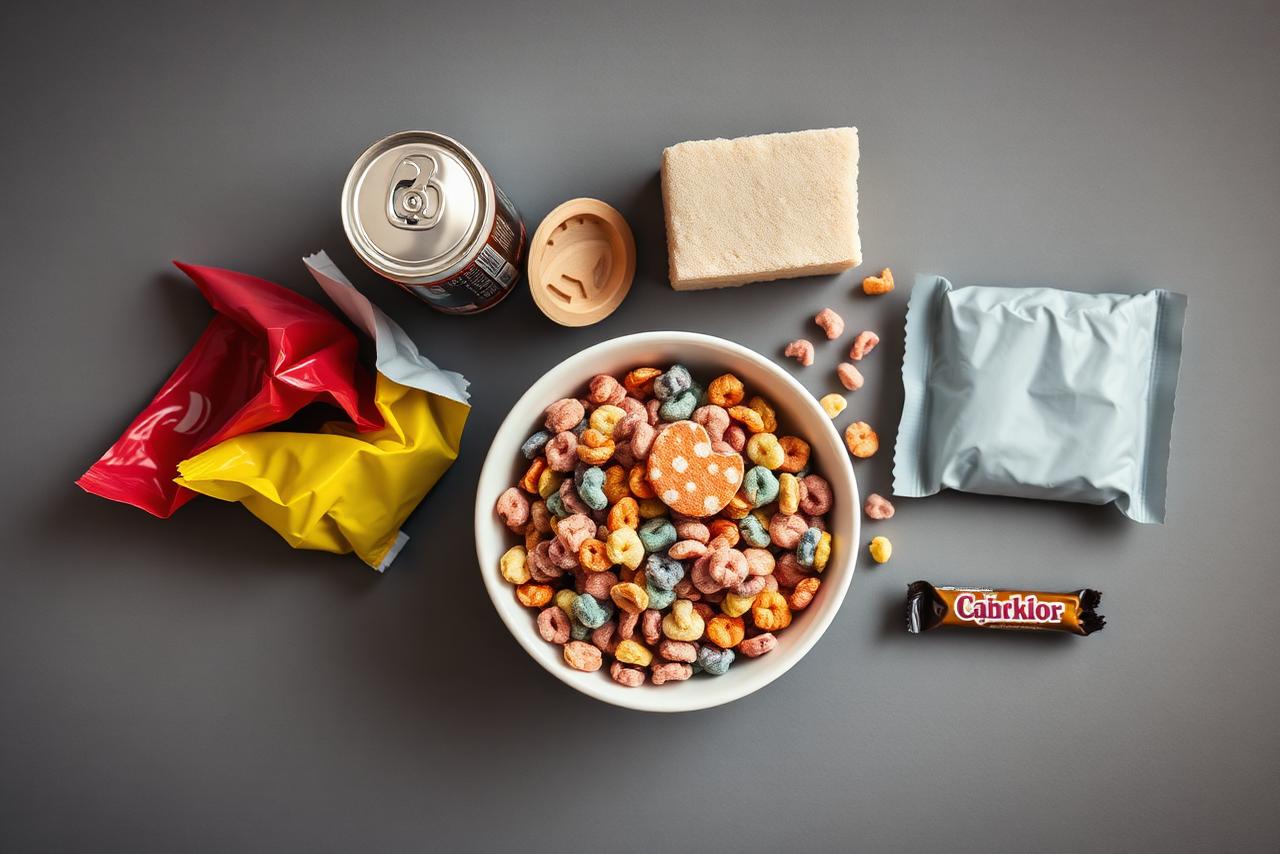
What is an ultra-processed food?
An ultra-processed food is a NOVA Group 4 product made through industrial processes using substances extracted from foods — oils, fats, sugars, starches, and protein isolates — combined with cosmetic additives such as emulsifiers, artificial colours, flavour enhancers, and non-nutritive sweeteners not sold to consumers for home cooking. The definition comes from Monteiro CA, et al., Public Health Nutrition (2019;22[5]:936–941), reaffirmed in the Pan American Health Organization guidance (PAHO 2015) and the UN Food and Agriculture Organization (FAO 2019) report. Synonyms in the literature include "industrial formulations" and, in French cohort work, "aliments ultra-transformés"; the hypernym is simply "processed food", but Group 4 is a strict subset.
What are the four practical markers of Group 4?
Group 4 status is identified from the ingredient list, not the nutrition panel — four markers are enough to classify a product with about 85% agreement across trained raters (Braesco V, et al., European Journal of Clinical Nutrition 2022;76:1245–1253).
- Industrial ingredients not sold in supermarkets — protein isolates, modified starches, hydrogenated or interesterified oils, high-fructose corn syrup, maltodextrin.
- Cosmetic additives used to mimic freshness, colour, or texture — colorants (Red 40, Yellow 5), flavour enhancers (MSG, disodium inosinate), emulsifiers (mono- and diglycerides, polysorbate 80), non-nutritive sweeteners (aspartame, sucralose).
- Five or more ingredients on the label — a rule-of-thumb threshold from Monteiro 2019 that catches most Group 4 items.
- Industrial processing techniques — extrusion (breakfast cereals, snacks), moulding (chicken nuggets, meat analogues), pre-frying (frozen chips, instant noodles), and hydrolysis (soy sauce, protein isolates).
What are typical examples of ultra-processed foods?
Ultra-processed foods account for 57% of daily energy intake in US adults (Juul F, et al., American Journal of Clinical Nutrition 2022;115[1]:211–221) and 27% in UK households (Rauber F, et al., BMJ Open 2019;9:e027546), so most of them are foods people buy every week.
- Soft drinks, flavoured waters, sports and energy drinks
- Packaged snacks, chips, extruded corn puffs, confectionery
- Most commercial breakfast cereals and cereal bars
- Instant noodles, instant soups, ready meals, frozen pizzas
- Reconstituted meat products — nuggets, sausages, deli slices
- Plant-based meat analogues built from protein isolates
- Flavoured yogurts, dessert pots, ice creams with emulsifier packages
- Commercial sauces, dressings, spreads, and "instant" mixes
What does the research show about ultra-processed food and health?
More than 30 prospective cohort studies plus one landmark randomised feeding trial, consolidated in a 2024 BMJ umbrella review of 9.9 million participants, associate higher UPF intake with worse outcomes after adjustment for total calories and macronutrients.
| Study | Population | n | Outcome | Effect (highest vs lowest quartile) |
|---|---|---|---|---|
| Rico-Campà A, et al. BMJ 2019;365:l1949 | SUN cohort, Spain | 19,899 | All-cause mortality | HR 1.62 (95% CI 1.13–2.33) |
| Srour B, et al. BMJ 2019;365:l1451 | NutriNet-Santé, France | 105,159 | Cardiovascular disease | HR 1.12 per 10% UPF increment |
| Fiolet T, et al. BMJ 2018;360:k322 | NutriNet-Santé, France | 104,980 | Cancer (overall) | HR 1.12 per 10% UPF increment |
| Hall KD, et al. Cell Metab 2019;30:67–77 | Randomised feeding trial (NIH) | 20 | Ad-libitum kcal intake | +508 kcal/day, +0.9 kg body weight in 2 weeks |
| Lane MM, et al. BMJ 2024;384:e077310 | Umbrella review, 45 meta-analyses | 9.9M | 32 adverse outcomes | Convincing evidence for mortality, CVD, T2D, common mental disorders |
The Hall trial is the most cited because it is the only randomised controlled feeding trial in this literature. Participants lived on a metabolic ward for two weeks per diet with meals matched for calories offered, sugar, fat, sodium, fibre, and macronutrients. On the UPF diet they still ate 508 kcal/day more, gained weight, and ate faster — the mechanistic thread other cohort studies had to infer from observational data.
What proposed mechanisms link UPF to health outcomes?
The current mechanistic story combines four pathways: hyper-palatability, matrix disruption, additive-driven microbiome changes, and industrial contaminants from processing.
- Hyper-palatability and eating rate. Fazzino TL, et al. (Obesity 2019;27[11]:1761–1768) showed 62% of US packaged foods hit hyper-palatable combinations of fat + salt, fat + sugar, or carb + salt; Hall 2019 measured a 17 g/min faster eating rate on UPF diets.
- Matrix disruption. Fardet A (Food & Function 2015;6:363–382) reviews 12 trials showing higher satiety per calorie from intact food matrices; extrusion and milling destroy the fibre-encapsulated starch and protein–lipid complexes.
- Emulsifier–microbiome interactions. Chassaing B, et al. (Nature 2015;519:92–96) showed carboxymethylcellulose and polysorbate 80 induced low-grade intestinal inflammation and metabolic syndrome markers in mice; the human RCT (Chassaing 2022, Gastroenterology 162:743–756) confirmed microbiota encroachment in humans consuming CMC.
- Neoformed contaminants. Acrylamide, furan, and 3-MCPD form during high-heat industrial processing (EFSA 2015 and 2016 opinions). Exposure levels in Group 4 diets exceed EFSA benchmark doses for concerned subpopulations.
How do you identify ultra-processed foods on a label?
Read the ingredient list before the nutrition panel. Any of the five markers below is enough to place a product in Group 4 in the standard NOVA classification protocol used by Monteiro's team.
- Five or more ingredients on the label.
- Any additive that exists to make the food look, taste, or feel like something else — colourants, flavour enhancers, non-nutritive sweeteners, emulsifiers, thickeners.
- Any ingredient your grandparent would not recognise — maltodextrin, mono- and diglycerides, soy protein isolate, hydrogenated oils, dextrose.
- Any industrial process name — hydrolysed, extruded, texturised, isolated, hydrogenated.
- A branded ingredient — proprietary flavour system, patented starch, or "natural flavour" that isn't a named plant or animal.
The full walk-through is in how to read a nutrition label — a two-minute checklist you can use in the aisle.
How does NakedCalorie score ultra-processed foods?
Group 4 items start at the bottom of the processing axis; each cosmetic additive on the label subtracts further from the score, with the specific additive and its regulatory context surfaced in the UI. The score never says "bad" — it displays the group, the flagged ingredients with links to their KB pages (for example Red 40 or high-fructose corn syrup), and the underlying source for every claim. Full weighting details live in What's inside. For the frame around the four groups, start with the NOVA classification system.
Frequently asked questions
- Is every packaged food ultra-processed?
- No. Packaging alone does not determine NOVA group. Plain canned tomatoes, tinned fish in olive oil, and frozen unseasoned vegetables are Group 3 or even Group 1. Ultra-processed status depends on the ingredient list — specifically, the presence of substances extracted from foods (protein isolates, modified starch, hydrogenated oils) and cosmetic additives (emulsifiers, colours, flavour enhancers, non-nutritive sweeteners) not sold for home cooking.
- Are ultra-processed foods harmful because of the calories or the processing?
- The Hall et al. randomised feeding trial (Cell Metabolism 2019;30:67–77) held calories offered, macros, sugar, fat, and fibre constant, and still saw participants eat 508 kcal/day more on the UPF diet. That suggests the processing itself — through matrix disruption, hyper-palatability, and faster eating rate — drives excess intake beyond what nutrient content predicts.
- Is bread ultra-processed?
- It depends on the ingredients. Artisan bread made from flour, water, salt, and yeast is NOVA Group 3. Industrial sliced bread with emulsifiers (mono- and diglycerides), dough conditioners (DATEM, sodium stearoyl lactylate), preservatives (calcium propionate), and added vital wheat gluten is Group 4. Read the ingredient list — 5+ ingredients with any technical-sounding names is the standard signal.
- Are plant-based meat alternatives ultra-processed?
- Most commercial plant-based meat analogues (Beyond Meat, Impossible Foods, and similar) meet NOVA Group 4 criteria — they combine protein isolates, extracted oils, methylcellulose, and colouring agents such as beetroot extract or leghemoglobin. Whole-food plant sources such as beans, lentils, tofu, and tempeh are Group 1 or Group 3.
- Does NakedCalorie tell me to avoid ultra-processed foods?
- No. The app displays the NOVA group and any flagged additives with links to the sources, and it lets you set your own weekly targets. There is no 'bad food' verdict, no red X, and no scolding. The score is descriptive and cited.
Written by NakedCalorie editorial team.
Medically reviewed by Pending registered dietitian review — last reviewed July 1, 2026.
Educational information only, based on peer-reviewed literature and regulatory sources. Not medical advice.
Related in the knowledge base