
Maltodextrin
Maltodextrin is a highly-processed carbohydrate produced by partial hydrolysis of starch — usually corn, rice, potato, or wheat — used as a thickener, bulking agent, and carrier in packaged foods, sports drinks, and supplements. Its glycemic index sits between 85 and 136, higher than table sugar.
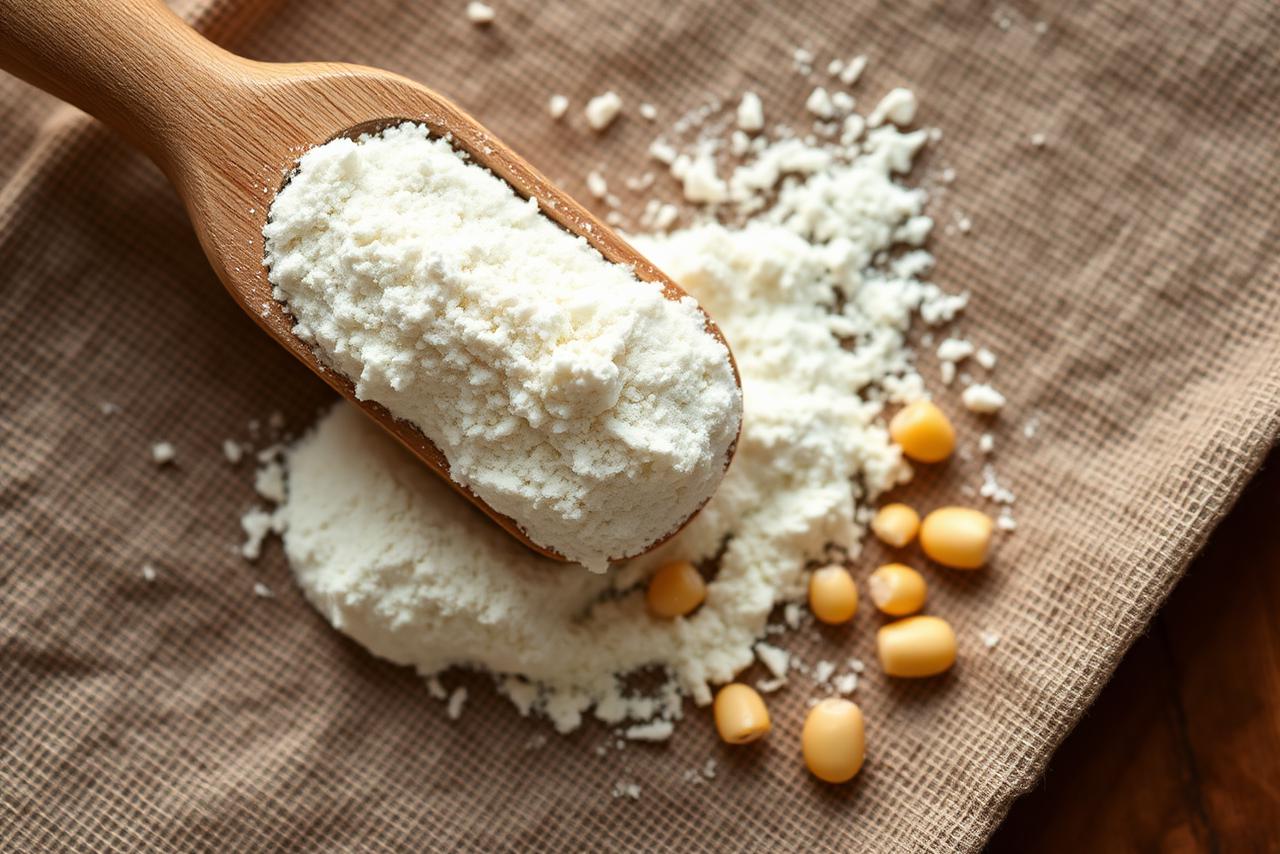
What is maltodextrin?
Maltodextrin is a highly-processed carbohydrate powder produced by partial enzymatic or acid hydrolysis of starch — most commonly corn, rice, potato, or wheat starch. It is legally classified as a food ingredient rather than a sugar, is FDA GRAS, and is one of the single most common items on ultra-processed food labels.
Chemically, maltodextrin is a chain of glucose units linked by α-1,4 and α-1,6 glycosidic bonds, with a chain length shorter than starch but longer than glucose. Its dextrose equivalent (DE) — a measure of the percentage of glycosidic bonds broken — sits between 3 and 20. Below DE 3 the product is a starch; above DE 20 it is a glucose syrup.
How is maltodextrin made?
Manufacturing starts with a food-grade starch slurry (typically corn in the US, wheat in Europe). The slurry is cooked to gelatinise the starch, then broken down with amylase enzymes or dilute acid to shorter glucose chains. The resulting syrup is filtered, refined, and spray-dried into a white, mildly-sweet powder that dissolves instantly in water.
- Starch extraction from the source grain — corn wet-milling for maltodextrin dextrose equivalent varies by target application.
- Gelatinisation — the starch slurry is heated above 60 °C to break up the granule structure.
- Hydrolysis — α-amylase enzymes cleave the starch chains at α-1,4 bonds; the reaction is stopped at the target DE.
- Refining — filtration, ion exchange, and evaporation remove impurities.
- Spray-drying — the concentrated syrup is atomised into a hot air stream and collected as a fine white powder.
The process is fast, continuous, and cheap. Corn maltodextrin sells wholesale at a fraction of the price of sucrose per unit of caloric bulk, which is one reason it has spread across almost every category of the ultra-processed food supply.
What foods contain maltodextrin?
- Sports drinks, gels, and endurance nutrition — fast-absorbing carb source.
- Protein bars and powders — bulking agent that improves texture and lets a bar hold its shape.
- Instant soups, sauces, and gravies — thickener and body-builder.
- Salad dressings, especially low-fat — replaces oil for mouthfeel.
- Non-nutritive sweetener blends — the bulking agent that gives sucralose or stevia the volume of sugar.
- Infant formulas and follow-on formulas — carbohydrate source alongside lactose.
- Medications and dietary supplements — carrier and tablet binder.
- Meat glazes, seasoning blends, and dry mixes — carrier for flavour compounds.
What does maltodextrin do metabolically?
Maltodextrin hydrolyses to glucose within minutes of reaching the small intestine and raises blood glucose faster than an equivalent amount of sucrose. Its published glycemic index falls between 85 and 136 depending on the DE and the food matrix — meaningfully higher than sucrose (GI 65) and comparable to pure glucose.
The metabolic implications are twofold. In endurance sport, that speed is a feature — carb-loading protocols and mid-race gels exploit it deliberately. In a sedentary Group 4 diet, it is a problem: the same fast glucose spike, without exercise to clear it, is the profile associated with post-prandial hyperinsulinemia in insulin-resistant adults (Ludwig 2002, JAMA).
A 2012 mouse study (Nickerson KP et al., PLoS ONE) reported that dietary maltodextrin promoted adhesion of adherent-invasive E. coli to intestinal epithelial cells and suppressed the antibacterial mucin response. A 2016 Journal of Crohn's and Colitis paper by the same group extended the finding to inflammatory-bowel-disease models. Human evidence is still limited, but the mechanism is a plausible contributor to microbiome-mediated effects of ultra-processed diets.
Is maltodextrin regulated?
Yes. Maltodextrin is FDA GRAS under 21 CFR 184.1444 and is approved for use in the EU without an E-number (it is classed as a food ingredient, not an additive). There is no upper limit on its use in either jurisdiction and no ADI.
The absence of an E-number is the reason maltodextrin escapes many consumer additive scanners despite being the most common single marker of ultra-processing on US labels. NakedCalorie treats it as a Tier 1 processing signal — always surfaced, always counted toward additive load, always contributing to the NOVA Group 4 trigger.
How does NakedCalorie flag maltodextrin?
Maltodextrin triggers a NOVA Group 4 classification on any product where it appears (per Monteiro 2019) and contributes to additive load as a Tier 1 processing marker. It does not carry the same individual weight as an artificial colour or an industrial emulsifier, but its presence typically indicates an ultra-processed formulation.
For the surrounding cluster, see the ingredient encyclopedia and the closely related sweeteners high-fructose corn syrup. For the Group 4 context, see Group 4 — ultra-processed foods.
Frequently asked questions
- Why does maltodextrin have a higher glycemic index than table sugar?
- Maltodextrin is composed of short glucose chains that hydrolyse to glucose almost instantly during digestion. Its published glycemic index sits around 85–136, higher than sucrose (65) or glucose itself (100 by definition). This makes it a fast-acting carb in sports drinks and a rapid glucose spike in packaged snacks.
- Is maltodextrin a hidden sugar?
- By label rules, no — it is not classified as a sugar and does not contribute to the added-sugars line on the US nutrition facts panel. Metabolically, yes — it is broken down to pure glucose in the small intestine and behaves like sugar in the bloodstream. NakedCalorie flags it as a Tier 1 processing signal alongside the added-sugars total.
- Is maltodextrin safe for people with diabetes?
- It is legal, but it is one of the harder ingredients for a diabetic diet to accommodate because it raises blood glucose faster than sucrose. Most diabetes education programs recommend reading for maltodextrin the same way you would read for sugar — as a carbohydrate that requires insulin or a compensating adjustment.
- Is maltodextrin gluten-free?
- Almost always. Even maltodextrin derived from wheat starch is processed to remove protein and is considered gluten-free under both FDA (below 20 ppm) and Codex standards. People with celiac disease can consume it safely in the vast majority of cases.
Written by NakedCalorie editorial team.
Medically reviewed by Pending registered dietitian review — last reviewed July 8, 2026.
Educational information only, based on peer-reviewed literature and regulatory sources. Not medical advice.
Related in the knowledge base
- IngredientsSoy lecithin
- NOVANOVA Group 4 — ultra-processed foods
- IngredientsCarrageenan