
Carrageenan
Carrageenan is a family of sulfated polysaccharides extracted from red seaweed (Rhodophyta), used as a gelling, thickening, and stabilising agent in dairy alternatives, deli meats, and infant formulas. It carries E-number E407 and food-grade approvals in the US, EU, and via JECFA, alongside an active peer-reviewed debate over its effect on the gut lining.
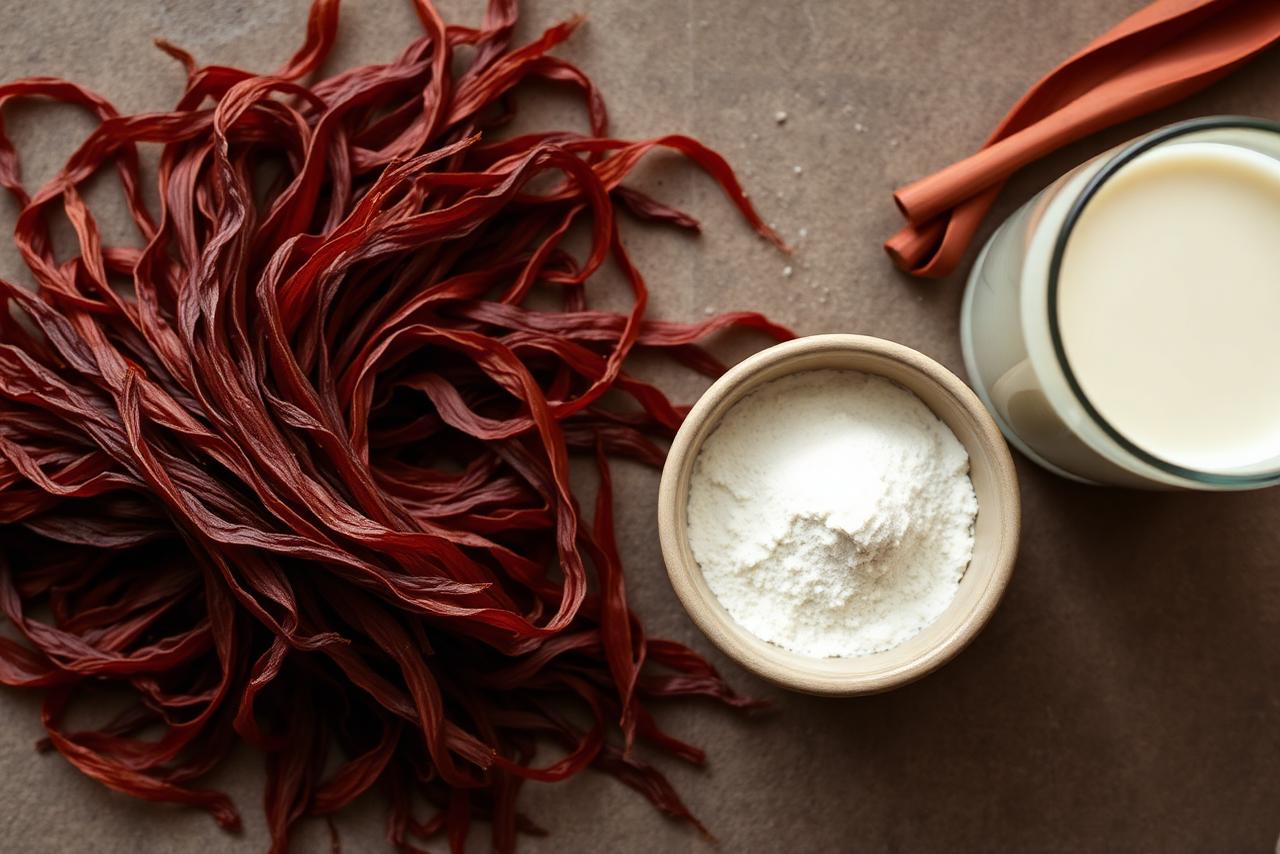
What is carrageenan?
Carrageenan is a family of high-molecular-weight sulfated polysaccharides extracted from certain species of red seaweed in the class Rhodophyta — principally Chondrus crispus, Eucheuma cottonii, and Eucheuma spinosum. It has E-number E407 in the European Union and is FDA GRAS under 21 CFR 172.620 (food-grade) and 21 CFR 172.626 (as a stabiliser).
Three commercial forms exist, distinguished by the position and number of sulfate groups on the polysaccharide backbone. Kappa carrageenan forms strong, brittle gels with potassium. Iota carrageenan forms softer, elastic gels with calcium. Lambda carrageenan does not gel but thickens cold liquids. Manufacturers choose the form to match the target texture.
How is carrageenan produced?
Harvested seaweed is washed, dried, and treated with an alkaline solution (typically potassium or sodium hydroxide) to solubilise the polysaccharide. The extract is filtered, precipitated with alcohol or potassium chloride, dried, and milled into a fine off-white powder.
- Harvest — mostly farmed Eucheuma from Indonesia and the Philippines; wild Chondrus from the North Atlantic.
- Cleaning and alkaline extraction.
- Filtration, concentration, and precipitation.
- Drying, milling, and standardisation to gel strength.
A separate "semi-refined" carrageenan (sometimes labelled PES — processed Eucheuma seaweed) skips the precipitation step and retains more of the original seaweed matter. Both forms are regulated under the same E-number in the EU.
What foods contain carrageenan?
- Plant-based milks — almond, oat, soy, coconut; stabilises against separation.
- Ice cream and frozen desserts — controls ice-crystal size, improves melt behaviour.
- Chocolate milk — keeps cocoa suspended.
- Deli meats and processed meats — improves slice yield and moisture retention.
- Infant formulas — historically used as a stabiliser; several manufacturers reformulated it out after consumer pressure in the mid-2010s.
- Yoghurt, especially low-fat and Greek-style — thickens without fat.
- Toothpaste and pharmaceuticals — non-food use as a suspending agent.
What does the research say about carrageenan and health?
The scientific debate divides into two questions: does food-grade carrageenan degrade to poligeenan in the digestive tract, and does undegraded carrageenan itself provoke intestinal inflammation? The regulatory position (JECFA 2015, EFSA 2018, FDA maintained approval) is that current evidence does not require a change to permitted uses. A minority of gastroenterology and toxicology researchers disagree.
The best-known critic is Prof. Joanne Tobacman at the University of Illinois Chicago, whose group published a series of papers from 2001 to 2018 arguing that food-grade carrageenan induces low-grade inflammation in colonic epithelial cells via a Toll-like receptor 4 mechanism, and that stomach acid can partially depolymerise the polysaccharide toward the poligeenan structure. JECFA reviewed the evidence in 2014–2015 and concluded that at typical dietary intakes it was not a concern; EFSA reached the same conclusion in a 2018 re-evaluation but flagged a data gap on infant exposure and recommended limiting use in infant formulas — several manufacturers had already voluntarily removed it.
The 2018 US National Organic Standards Board vote removed carrageenan from the National List of substances allowed in organic food after a public-comment period dominated by concerns from parents and gastroenterologists. Conventional US and EU approvals were unaffected.
Is carrageenan the same as poligeenan?
No. Food-grade carrageenan has a molecular weight above 100 kDa and is regulated as a distinct substance. Poligeenan (formerly called degraded carrageenan) has a molecular weight of 10–20 kDa and is used deliberately in animal studies to induce colitis. Food-grade carrageenan cannot be sold if it contains more than 5% low-molecular-weight fragments per JECFA specifications.
Much of the confusion in the public conversation comes from citing poligeenan studies as if they were food-grade carrageenan studies. They are not. The genuine research question is whether small amounts of low-molecular-weight fragments can form in the human digestive tract from the food-grade material — a mechanism Tobacman's group has argued for, and one JECFA and EFSA have concluded is not supported by the current body of evidence.
How does NakedCalorie flag carrageenan?
Carrageenan is marked as a Tier 2 evidence-linked additive in the ingredient encyclopedia — surfaced individually on every scan, contributing to additive load, and triggering NOVA Group 4 classification. The tier reflects the contested but non-trivial research base and the fact that several major manufacturers have voluntarily removed the ingredient from infant formulas and organic products.
For the emulsifier/thickener context, see xanthan gum and mono- and diglycerides. For the Group 4 classification rule, see Group 4 — ultra-processed foods.
Frequently asked questions
- Is carrageenan the same as poligeenan?
- No. Poligeenan (formerly 'degraded carrageenan') is a lower-molecular-weight variant used in laboratory studies to induce inflammation. It is not approved for use in food. Food-grade carrageenan is a distinct, high-molecular-weight preparation regulated separately by the FDA, EFSA, and JECFA.
- Is carrageenan vegan?
- Yes. It is extracted from red seaweed and contains no animal products. It appears in many plant-based dairy alternatives — almond, oat, and soy milks, plant-based ice creams — precisely because it stabilises those matrices without gelatin.
- Was carrageenan removed from organic foods?
- In 2018 the US National Organic Standards Board voted to remove carrageenan from the National List of substances allowed in organic food. The USDA implemented the removal, and organic manufacturers reformulated with alternative stabilisers (gellan gum, xanthan gum, agar). Carrageenan remains permitted in conventional US and EU foods.
- Is carrageenan an emulsifier?
- Functionally it can act as one, but it is more accurately a gelling agent and hydrocolloid stabiliser. It works by forming a weak gel network that prevents separation, not by reducing interfacial tension between oil and water the way lecithins or polysorbates do.
Written by NakedCalorie editorial team.
Medically reviewed by Pending registered dietitian review — last reviewed July 8, 2026.
Educational information only, based on peer-reviewed literature and regulatory sources. Not medical advice.
Related in the knowledge base
- IngredientsXanthan gum
- IngredientsMono- and diglycerides
- NOVANOVA Group 4 — ultra-processed foods