
Soy lecithin
Soy lecithin is a mixture of phospholipids extracted from soybean oil during degumming and used as an emulsifier to blend fats with water in chocolate, margarine, baked goods, and infant formula. It carries E-number E322(i) and is one of the most widely used emulsifiers in the global food supply.
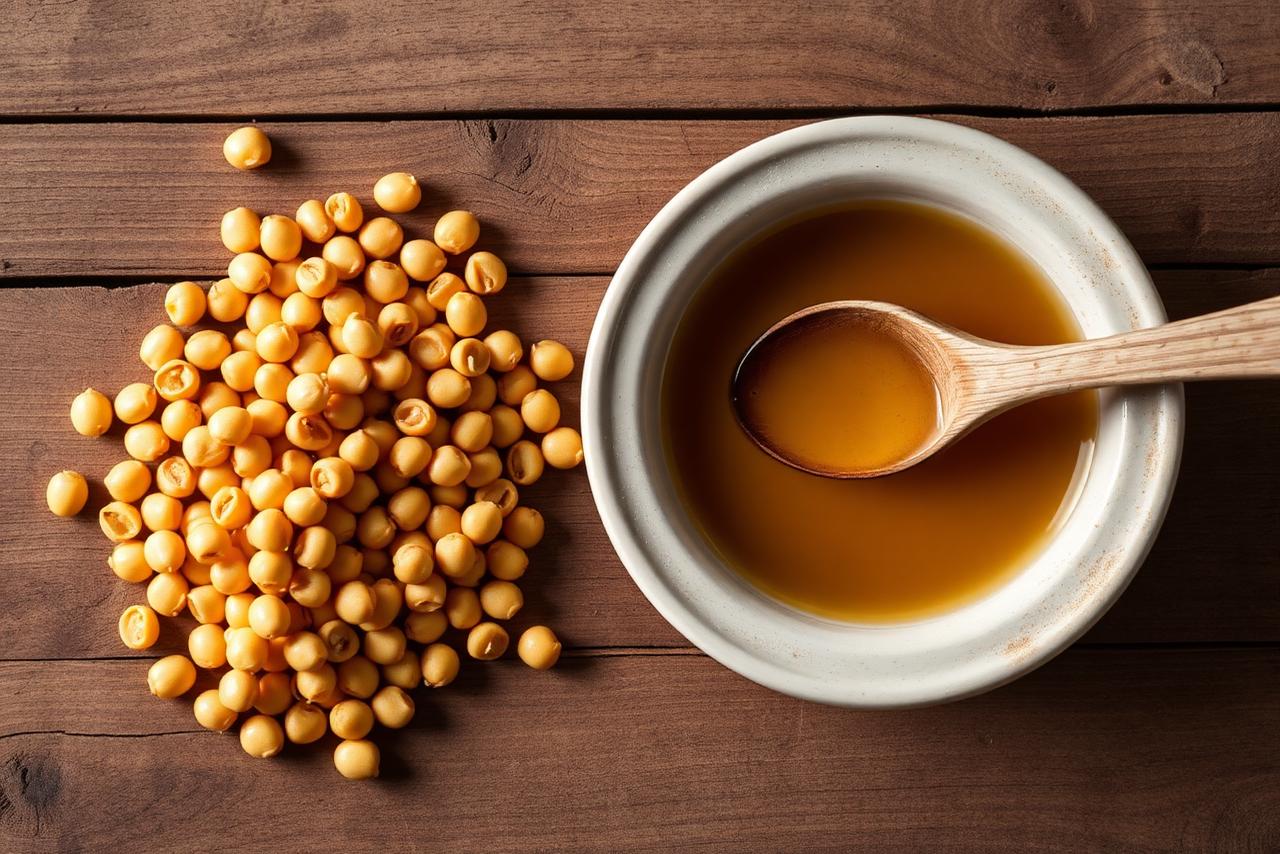
What is soy lecithin?
Soy lecithin is a mixture of phospholipids — mainly phosphatidylcholine, phosphatidylethanolamine, and phosphatidylinositol — extracted from soybean oil during the degumming step of vegetable-oil refining. It is used as an emulsifier, meaning it stabilises mixtures of fat and water that would otherwise separate.
The active feature of every phospholipid is its amphiphilic structure — one end is polar and interacts with water, the other end is non-polar and interacts with fat. Phospholipids sit at the oil-water interface and prevent droplets from coalescing. Cell membranes across every living organism work by the same principle; soy lecithin is a bulk-commodity version of the molecule.
How is soy lecithin made?
- Soybean crushing. Soybeans are cracked, dehulled, and pressed or hexane-extracted to yield crude soybean oil.
- Degumming. Water is mixed into the crude oil; phospholipids hydrate, become insoluble in the oil phase, and are separated by centrifugation as "gums."
- Drying and refining. The gums are dried to remove water and standardised for phospholipid content, yielding fluid soy lecithin.
- Optional fractionation. The lecithin can be further separated into hydrolysed, deoiled (powdered), or phosphatidylcholine-enriched forms for specific applications.
The process is a byproduct of soybean oil refining rather than a standalone manufacture. World production tracks soybean oil production, which crossed 60 million tonnes annually in the early 2020s. Soy lecithin is one of the cheapest emulsifiers on the market as a result.
What foods contain soy lecithin?
- Chocolate and cocoa products — reduces cocoa butter usage by 3–5%, improves flow during moulding.
- Margarine, low-fat spreads, whipped toppings — stabilises the water-in-oil or oil-in-water emulsion.
- Baked goods — improves dough handling and crumb structure.
- Infant formula — helps stabilise the fat-in-water emulsion of reconstituted formula.
- Non-dairy milks and creamers — keeps oil droplets dispersed.
- Convenience foods, sauces, dressings — general-purpose emulsifier.
- Cooking sprays — often the second ingredient after the propellant.
- Pharmaceuticals and dietary supplements — capsule shell component, tablet lubricant.
What does the research say about soy lecithin?
Soy lecithin has one of the cleaner regulatory histories among common emulsifiers. It carries no ADI restriction from JECFA or EFSA and no documented direct health signal in the epidemiological literature. Both agencies have concluded that dietary intakes are far below any level that produces effects in animal toxicology.
The broader emulsifier debate — Chassaing et al. (Nature, 2015) on polysorbate-80 and carboxymethylcellulose; the 2022 Gastroenterology follow-up on carboxymethylcellulose; the 2023 NutriNet-Santé emulsifier-total analysis in The BMJ — has not specifically implicated lecithins. The Chassaing group tested polysorbate and cellulose derivatives because they are known to disrupt intestinal mucus in animal models; lecithins are the natural building block of that same mucus layer and the parallel effect is not seen.
The 2015 EFSA re-evaluation of E322 confirmed the safety of soy lecithin at all typical dietary uses and identified no need to set an ADI. The one operational safety concern is allergen labelling: because trace soy protein can survive the extraction, the EU requires E322 to be labelled as a soy derivative, and the FDA requires "soy lecithin" to appear on the label rather than the neutral "lecithin."
How does soy lecithin fit into the NOVA framework?
Presence of soy lecithin classifies a product as NOVA Group 4 under the Monteiro 2019 decision rule. Any cosmetic additive — and lecithin is a cosmetic emulsifier when used to blend industrial fat and water phases — triggers the classification, regardless of the rest of the ingredient list.
The Group 4 trigger does not imply that soy lecithin is directly harmful. It signals that the product was formulated with the industrial toolkit — protein isolates, refined oils, and emulsifiers — rather than assembled from Group 1 and Group 2 items alone. That signal is what NakedCalorie surfaces on every scan.
How does NakedCalorie flag soy lecithin?
Soy lecithin is a Tier 1 processing signal in the ingredient encyclopedia — always counted toward additive load, always contributing to the NOVA Group 4 trigger, but not individually flagged as an evidence-linked concern.
For related emulsifiers with stronger evidence bases, see mono- and diglycerides and carrageenan. For the general emulsifier context, see the emulsifier section on the additives hub.
Frequently asked questions
- Is soy lecithin safe for people with soy allergies?
- Most soy-allergic individuals tolerate soy lecithin because commercial extraction removes almost all soy protein. However trace residues can remain, and both the FDA and EFSA require labelling as a soy-derived ingredient. Severely allergic individuals should still avoid it.
- Is soy lecithin the same as sunflower lecithin?
- Functionally yes; they are near-interchangeable in most recipes. Sunflower lecithin is extracted from sunflower seed oil rather than soybean oil, avoids the top-9 allergen labelling requirement in the US, and is preferred in many organic and 'clean-label' products. Both have the same E-number (E322) in the EU.
- Does soy lecithin contain estrogens?
- No. Soy isoflavones (the plant estrogens in soy) are polar molecules that stay with the water fraction of the soybean. Lecithin is a phospholipid that stays with the oil fraction. Commercial soy lecithin contains negligible isoflavone content.
- Is soy lecithin a NOVA Group 4 marker?
- Yes. Per Monteiro et al. (2019), presence of any cosmetic emulsifier — including lecithins — moves a product into Group 4. NakedCalorie treats it as a Tier 1 processing signal.
Written by NakedCalorie editorial team.
Medically reviewed by Pending registered dietitian review — last reviewed July 8, 2026.
Educational information only, based on peer-reviewed literature and regulatory sources. Not medical advice.
Related in the knowledge base
- IngredientsMono- and diglycerides
- IngredientsCarrageenan
- NOVANOVA Group 4 — ultra-processed foods