
NOVA Group 1 — unprocessed and minimally processed foods
NOVA Group 1 covers whole foods and foods altered only by drying, refrigeration, freezing, pasteurisation, grinding, or roasting — with no added salt, sugar, oil, or industrial additives. It is the base of the diet in the Brazilian Dietary Guidelines and the highest-scoring group in NakedCalorie's food-quality score.
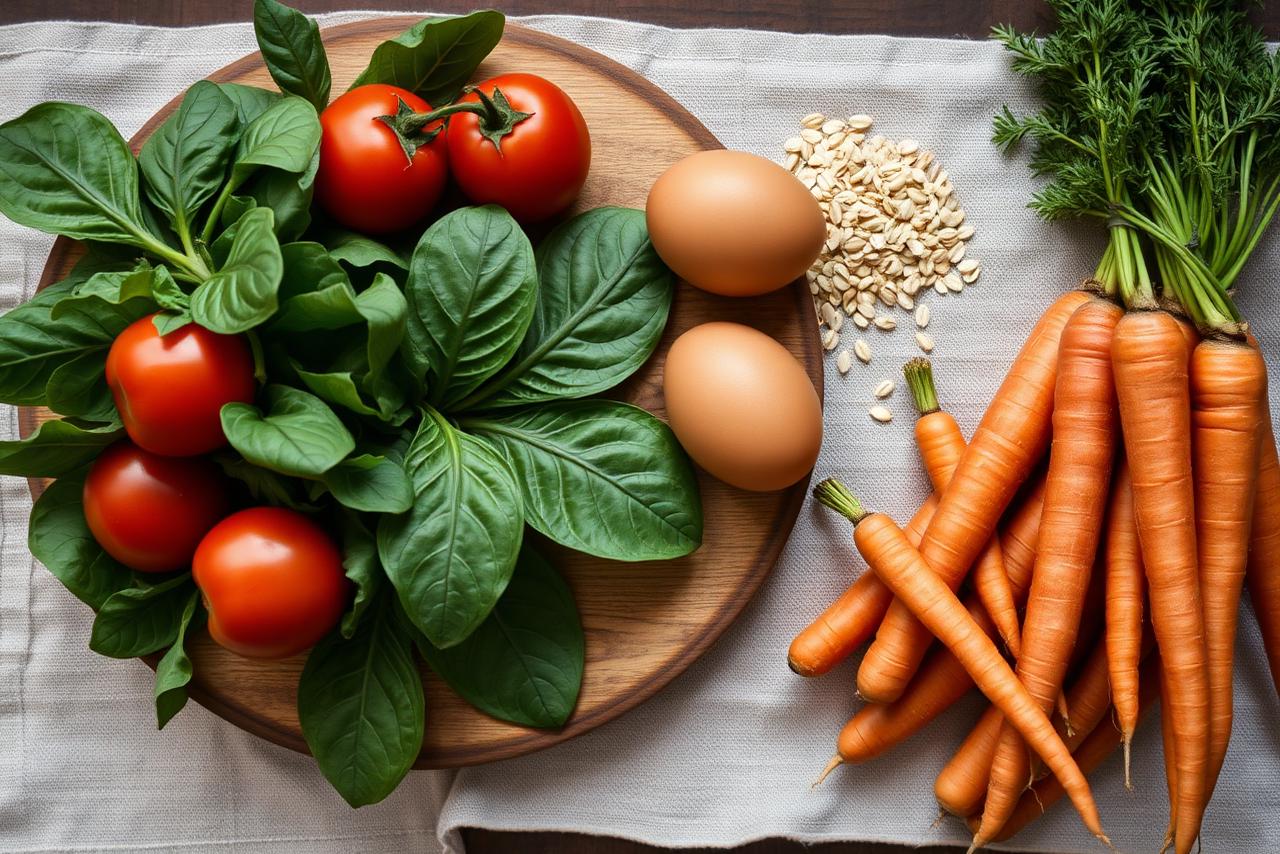
What is NOVA Group 1?
NOVA Group 1 covers unprocessed and minimally processed foods — whole foods eaten as they come from a plant, animal, fungus, alga, or water, plus foods altered only by removing inedible parts, drying, refrigeration, freezing, pasteurisation, grinding, non-alcoholic fermentation, or roasting, with no added salt, sugar, oil, or industrial additives. The physical form of the food changes; nothing is added.
This is the base of the diet in the framework Monteiro et al. codified in Public Health Nutrition in 2016 and refined in a 2019 decision-rule paper. The Brazilian Dietary Guidelines (2014, revised 2024), the French PNNS 4 recommendations, and the Uruguayan and Peruvian guidelines all instruct citizens to make Group 1 foods the basis of every meal.
What foods count as Group 1?
The Monteiro group's canonical list is broad. It covers every whole plant food, every whole animal food, and every mineral water on the market, provided nothing has been added.
- Fruits — fresh, chilled, frozen, plain dried; whole, cut, or juiced only if freshly squeezed with no additions.
- Vegetables — fresh, chilled, frozen; whole, cut, or plainly pureed.
- Roots and tubers — potato, sweet potato, yuca, taro, plantain.
- Grains — whole or ground: brown rice, white rice, oats, wheat berries, quinoa, buckwheat, cornmeal.
- Pulses — dried or freshly cooked lentils, chickpeas, black beans, kidney beans, split peas.
- Nuts and seeds — raw or dry-roasted, no added salt or oil.
- Meat, poultry, fish, seafood — fresh, chilled, frozen; unseasoned and untreated with additives.
- Eggs — whole, in-shell.
- Milk and plain yoghurt — pasteurised, UHT, powdered; no added sugar, flavour, or stabilisers.
- Herbs and spices — fresh or dried, single ingredient.
- Water — tap, spring, mineral, filtered.
- Tea and coffee — loose-leaf tea, tea bags, ground coffee, whole beans; brewed with no additions.
Pasteurisation is Group 1. Homogenisation is Group 1. Vacuum packing is Group 1. Freezing, refrigeration, and drying are all Group 1. The single distinguishing feature of the group is the absence of any added substance.
What processes are permitted at Group 1?
Monteiro et al. (2019) list the permitted minimal processing methods explicitly. They preserve or make the food edible without changing its nutritional composition in a meaningful way.
- Removal of inedible parts (peeling, deboning, shelling)
- Cleaning, washing, sorting
- Cutting, chopping, grinding, milling, flaking
- Roasting, blanching, boiling in water without added ingredients
- Cooling, chilling, freezing
- Drying (sun-drying, spray-drying of milk, freeze-drying of coffee)
- Pasteurisation of milk and juices
- Non-alcoholic fermentation (plain yoghurt, sauerkraut without preservatives, kimchi without added sugar)
- Vacuum and modified-atmosphere packaging
Every method on this list has a food-tradition analogue that predates industrial food production. What is not on the list — hydrogenation, extrusion, hydrolysis, high-pressure homogenisation combined with additives, spray-drying with carriers — moves the food into Group 3 or Group 4.
Where is the boundary between Group 1 and Group 3?
The boundary is crossed the moment a Group 2 ingredient — salt, sugar, oil, butter, vinegar — is added to a Group 1 food.
- Plain oats — Group 1. Instant oatmeal with sugar and flavour — Group 4.
- Fresh tuna — Group 1. Canned tuna in oil with salt — Group 3.
- Fresh tomato — Group 1. Canned peeled tomato with salt — Group 3.
- Plain almonds — Group 1. Roasted salted almonds — Group 3.
- Cucumber — Group 1. Cucumber pickled with salt and vinegar — Group 3.
The distinction matters because Group 3 foods can still form a healthy diet in reasonable amounts — the Brazilian guidelines describe them as "acceptable when used in small amounts, combined with fresh or minimally processed foods." Group 4 foods, by contrast, should be avoided. The two boundaries are different in kind.
Why does Group 1 matter for health?
The direct evidence on Group 1 intake mirrors the inverse evidence on Group 4 intake: diets dominated by unprocessed and minimally processed foods are consistently associated with lower cardiovascular mortality, lower incidence of type 2 diabetes, and lower all-cause mortality in prospective cohorts.
Rico-Campà et al. (The BMJ, 2019) followed 19,899 Spanish adults for a median 10.4 years and found a 62% higher risk of all-cause mortality in the top quartile of ultra-processed intake compared with the bottom quartile — with the bottom quartile eating a diet dominated by Group 1 and Group 3 foods. The Moli-sani cohort (Bonaccio et al., 2022) reported a 19% higher cardiovascular mortality in the top UPF quartile in 22,895 Italian adults. Kevin Hall's 2019 controlled feeding trial at the NIH found that adults consumed about 500 kcal/day more on an ultra-processed menu than on a matched menu built from Group 1 and Group 3 foods.
The mechanisms remain under study — energy density, fibre displacement, satiety signalling, additive effects on the microbiome — but the population-level pattern is consistent enough that the WHO, PAHO, and FAO all reference the Group 1 recommendation in their guidance.
How does NakedCalorie score Group 1 foods?
Group 1 items sit at the top of the processing axis in NakedCalorie's food-quality score and carry no additive flags, so their score is high by construction. The app still shows the calorie and macro breakdown — "high processing score" does not mean "eat unlimited."
A 200 g serving of raw almonds scores at the top of the processing axis but delivers roughly 1,150 kcal and 100 g of fat, so it will register in the diary as a high-calorie snack. A 200 g serving of raw broccoli scores identically on processing but is 70 kcal. The food-quality score describes the ingredient, not the portion; the diary describes the portion.
For the full framework and the other three groups, see the NOVA overview. For the boundary above Group 1, see Group 2 — processed culinary ingredients and Group 3 — processed foods.
Frequently asked questions
- Is frozen fruit still Group 1?
- Yes. Freezing is a Group 1 preservation method. Plain frozen berries, plain frozen vegetables, and plain frozen fish with no added salt, sugar, oil, or sauces remain Group 1. A frozen berry mix with added sugar or a frozen vegetable medley with a butter-flavour sauce moves to Group 3 or Group 4 depending on the ingredient list.
- Is pasteurised milk Group 1?
- Yes. Pasteurisation is listed in the Monteiro 2019 framework as a minimal-processing method. Plain pasteurised or ultra-pasteurised milk stays Group 1. Flavoured milk, sweetened milk, or milk with added stabilisers moves to Group 4.
- Are ground coffee, tea, and drinking water Group 1?
- Yes. Ground and roasted coffee, tea leaves, and drinking water are explicitly Group 1 in Monteiro et al. (Public Health Nutrition 2019;22[5]:936–941). Instant coffee with added maltodextrin or sweetened bottled tea moves to Group 4.
- Is plain yoghurt Group 1?
- Yes, when it is made from milk and live cultures only. Yoghurt with added sugar, sweeteners, fruit preparations, thickeners (pectin, gelatin, starch), or flavours moves to Group 4. Read the ingredient list: if there is anything beyond milk and cultures, the product is not Group 1.
- What about dried fruit, nuts, and seeds?
- Plain dried fruit with no added sugar, oil, or preservatives is Group 1. So are raw or dry-roasted nuts and seeds with no added salt or oil. Salted, sugared, or oil-roasted versions move to Group 3.
Written by NakedCalorie editorial team.
Medically reviewed by Pending registered dietitian review — last reviewed July 8, 2026.
Educational information only, based on peer-reviewed literature and regulatory sources. Not medical advice.
Related in the knowledge base