
High-fructose corn syrup (HFCS)
High-fructose corn syrup is a caloric sweetener produced by enzymatically converting a portion of the glucose in corn starch to fructose, typically to 42% or 55% fructose content. It is the dominant sweetener in US soft drinks and appears widely across the US packaged-food supply.
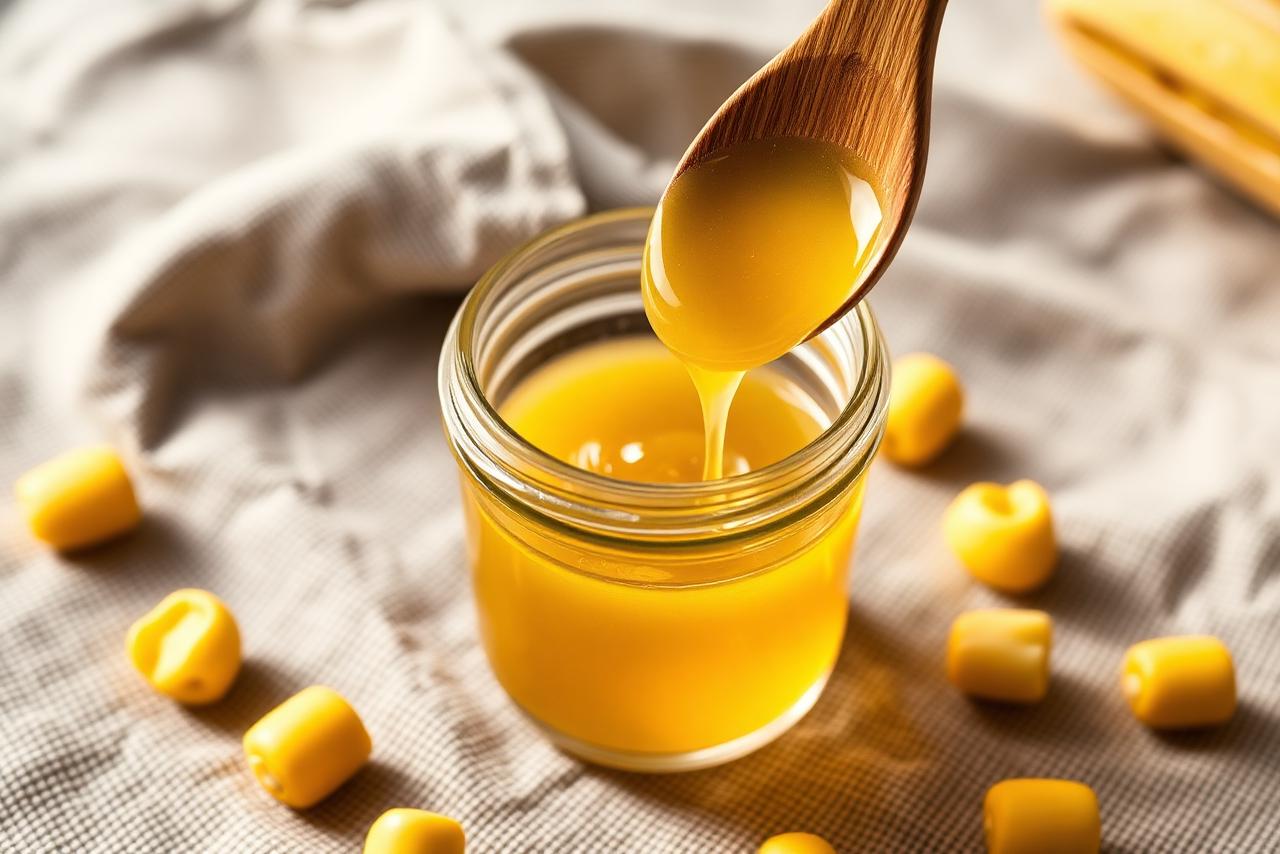
What is high-fructose corn syrup?
High-fructose corn syrup (HFCS) is a caloric sweetener produced by enzymatically converting a portion of the glucose in corn starch to fructose. The two dominant commercial grades are HFCS-42 (42% fructose, 53% glucose, 5% higher saccharides) used mainly in baked goods and cereals, and HFCS-55 (55% fructose, 42% glucose) used mainly in carbonated soft drinks.
Both grades are viscous, colourless liquids that are cheaper per gram of sweetness than crystalline sucrose in the US market. HFCS is FDA GRAS under 21 CFR 184.1866, is approved in the EU under the name "isoglucose" (E-number not required for a sweetener), and carries no ADI.
How is HFCS made?
- Corn wet-milling. Field corn is steeped, milled, and separated into starch, germ, fibre, and gluten.
- Starch hydrolysis. Corn starch is broken down to glucose syrup with α-amylase and glucoamylase.
- Isomerisation. A portion of the glucose is converted to fructose by immobilised xylose isomerase, producing HFCS-42.
- Fractionation. Chromatographic separation enriches the fructose fraction; blending with HFCS-42 produces HFCS-55.
- Refining and storage. The syrup is filtered, decolourised, and shipped in tanker trucks or rail cars.
The chain is fast, continuous, and highly automated. The US HFCS industry consumed roughly 5% of the annual US corn crop at its 2007 peak; consumption has declined about 40% since as manufacturers reformulate away from the sweetener under consumer pressure, but total added-sugar intake has not tracked the same drop.
How does HFCS compare to sucrose chemically?
Sucrose is a disaccharide (one glucose + one fructose molecule linked by a glycosidic bond). It is cleaved in the small intestine by sucrase-isomaltase into free glucose and fructose in a 1:1 ratio. HFCS-55 arrives already cleaved, with roughly 1:1 glucose-to-fructose but a slight fructose surplus. The metabolic difference at typical intake is small.
| Sweetener | Fructose % | Glucose % | Cleaved in gut? |
|---|---|---|---|
| Sucrose (table sugar) | 50 | 50 | Yes, by sucrase-isomaltase |
| HFCS-42 | 42 | 53 | Already cleaved |
| HFCS-55 | 55 | 42 | Already cleaved |
| Honey | ~38–41 | ~31–35 | Already cleaved (partial sucrose) |
| Agave syrup | 70–90 | ~10–30 | Already cleaved |
The independent variable most cohorts actually track is total added-sugar intake as a percentage of daily calories. The WHO's 2015 sugars guideline recommends limiting free sugars to below 10% of daily energy, with a conditional recommendation to reduce below 5% for additional benefit. US adults averaged 13% in 2017–2018 (NHANES).
What are the metabolic concerns specific to fructose?
Unlike glucose, fructose is metabolised almost entirely in the liver. High chronic fructose intake — from any source — is linked in controlled feeding studies to increased de novo lipogenesis, higher fasting triglycerides, and increased liver fat.
Stanhope et al. (Journal of Clinical Investigation, 2009) fed overweight adults 25% of daily energy as either glucose or fructose beverages for 10 weeks. The fructose group showed higher visceral fat accumulation and increased de novo lipogenesis; the glucose group did not. Softic et al. (Cell Metabolism, 2017) reviewed the mechanism in detail. The results apply to fructose as a class — sucrose, HFCS, honey, agave — not specifically to HFCS.
The Malik et al. 2022 Nature Reviews Endocrinology analysis — the most comprehensive recent review — concluded that sugar-sweetened beverages, regardless of specific sweetener, are causally linked to weight gain, type 2 diabetes, and cardiovascular disease. HFCS is the dominant sweetener in that category in the US; sucrose is the dominant sweetener in the same category in the EU. The health signal follows the beverage category more than the sweetener choice.
Where does HFCS appear beyond soft drinks?
- Fruit-flavoured drinks, sports drinks, iced teas
- Breakfast cereals and cereal bars
- Yoghurts, especially flavoured and low-fat
- Salad dressings, ketchup, barbecue sauce
- Baked goods — cookies, cakes, pastries, sweet breads
- Ice cream and frozen desserts
- Jams, jellies, syrups
- Frozen meals and glazes on processed meats
How does NakedCalorie flag HFCS?
HFCS triggers NOVA Group 4 classification per Monteiro 2019 and is surfaced in every scanned product's ingredient breakdown. It counts toward added-sugar totals in the nutrition panel and contributes to the food-quality score's sweetener load.
The score does not privilege sucrose over HFCS or vice versa; a product sweetened with cane sugar and a product sweetened with HFCS-55 receive the same added-sugar treatment. The difference NakedCalorie surfaces is not sugar type but total added-sugar volume and its position in the ingredient list. See maltodextrin for the closely related refined-starch sweetener and aspartame for the non-caloric replacement path.
Frequently asked questions
- Is HFCS worse for you than table sugar?
- The evidence is mixed. HFCS-55 (55% fructose) is chemically close to sucrose (50% fructose after enzymatic cleavage in the small intestine). Most large cohorts point at total added sugars as the health signal, not the specific sweetener. What is clear is that HFCS is almost exclusively found in ultra-processed foods, which carries risks in its own right (Malik et al., Nature Reviews Endocrinology 2022;18:205–218).
- Why did HFCS replace sugar in the US?
- Cost and policy. US sugar tariffs and quotas since the 1970s have kept domestic sucrose prices well above world levels, while corn subsidies have kept corn cheap. HFCS is manufactured domestically from cheap corn and has been the dominant caloric sweetener in US carbonated soft drinks since the mid-1980s. In the EU, without the same tariff structure, cane and beet sucrose remained dominant.
- Is HFCS in every soft drink?
- In the US, in most conventional soft drinks yes. Coca-Cola and PepsiCo standard bottles are sweetened with HFCS-55. 'Mexican Coke' sold in the US as an import is sweetened with sucrose. In the EU and much of Asia the standard formulation uses sucrose.
- Is HFCS the same as agave syrup?
- Chemically closer than most consumers realise. Agave syrup is typically 70–90% fructose — a higher fructose fraction than HFCS-55. The health argument for agave over HFCS is not supported by its fructose content; its main real advantage is a lower glycemic response due to the higher fructose share, which is a mixed blessing given fructose's specific effects on the liver.
Written by NakedCalorie editorial team.
Medically reviewed by Pending registered dietitian review — last reviewed July 8, 2026.
Educational information only, based on peer-reviewed literature and regulatory sources. Not medical advice.
Related in the knowledge base
- IngredientsMaltodextrin
- NOVANOVA Group 4 — ultra-processed foods
- SweetenersAspartame