
Dietary fats
Dietary fat is the macronutrient with the highest energy density (9 kcal/g) and the widest structural variety. The DGAs 2020–2025 recommend 20–35% of calories from fat, less than 10% from saturated fat, and industrial trans fat kept as low as possible — the WHO REPLACE initiative targets <1%.
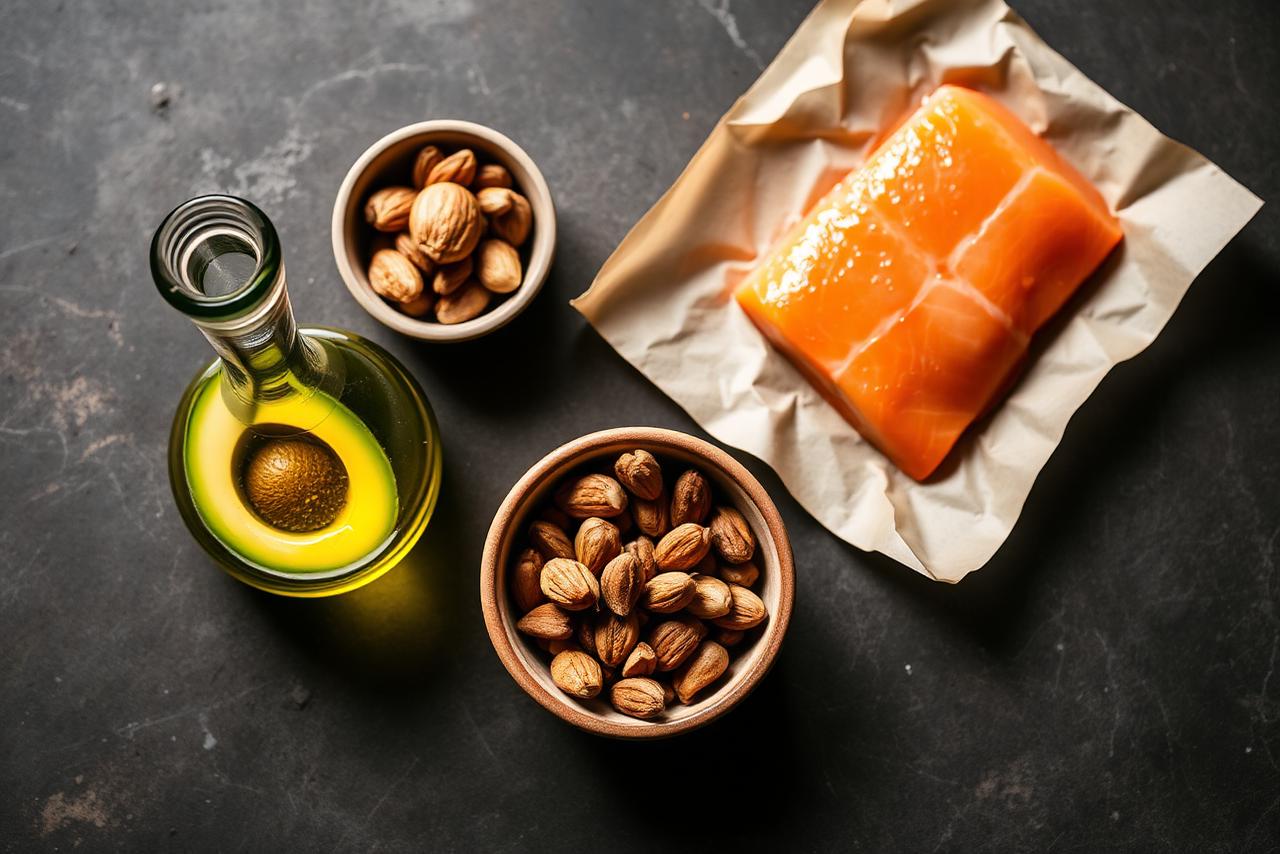
What is dietary fat?
Dietary fats are triglycerides — a glycerol backbone bound to three fatty acids — categorised by the number and position of double bonds in the fatty-acid chain. Saturated fatty acids have none; monounsaturated fatty acids (MUFA) have one; polyunsaturated (PUFA) have two or more. Trans fatty acids are a stereochemical variant with a trans- configured double bond that changes how the molecule packs and how the liver metabolises it.
Intake references
- AMDR (IOM): 20–35% of daily calories from total fat.
- Saturated fat (DGA 2020–2025): below 10% of calories.
- Saturated fat (AHA): below 6% for adults with elevated LDL.
- Trans fat (WHO REPLACE): below 1% of total energy; industrial trans fat eliminated from the food supply by 2023.
- Omega-3 (EPA + DHA, EFSA): 250 mg/day for adults; 100–250 mg/day for cardiovascular prevention.
Structural classes and food sources
| Class | Dominant food sources | Effect on LDL-C |
|---|---|---|
| Saturated (SFA) | Butter, cheese, fatty red meat, coconut oil, palm oil | Raises |
| Monounsaturated (MUFA) | Olive oil, avocado, most nuts | Neutral to mildly lowering |
| Omega-6 PUFA | Sunflower, corn, soybean oil; nuts and seeds | Lowers |
| Omega-3 PUFA | Salmon, sardines, mackerel, flax, chia, walnuts, algae | Neutral; lowers triglycerides at high dose |
| Industrial trans (iTFA) | Partially hydrogenated oils in shortenings, older margarine, some bakery | Raises; also lowers HDL |
What the outcome evidence says
Cochrane's 2020 review (Hooper, Cochrane Database Syst Rev 2020;5:CD011737) pooled 15 RCTs with 59,000 participants and estimated a 21% reduction in cardiovascular events when saturated fat was replaced by polyunsaturated fat. The Sacks/AHA presidential advisory (Circulation 2017;136:e1–e23) is consistent. What both documents stress — and headlines usually miss — is the replacement nutrient: SFA → PUFA lowers risk, SFA → refined carbohydrate does not.
For trans fat, the WHO REPLACE initiative (2018) targets elimination of industrial trans fat globally by 2023. Countries that acted early (Denmark 2004, US FDA 2015 GRAS revocation effective 2018) saw immediate declines in CHD mortality attributable to iTFA (Restrepo, Journal of Health Economics 2016;45:185–194).
Fats in Group 4 products
The specific fats in most Group 4 products are palm oil, partially hydrogenated oils where still legal, and refined seed oils — chosen for cost, shelf stability, and mouthfeel rather than nutritional profile. See hydrogenated oils, palm oil, and seed oils for the ingredient-level view.
How NakedCalorie treats fat
Grams of total fat, saturated fat, and trans fat are shown but do not directly drive the score. What moves the score is the presence of hydrogenated oils, the NOVA group, and the additive profile — not a threshold on total fat percent. See saturated vs unsaturated fat, trans fat, and omega-3 vs omega-6 for the sub-topic detail.
Frequently asked questions
- Should I be worried about saturated fat?
- The AHA (Sacks, Circulation 2017;136:e1–e23) and 2020 Cochrane review (Hooper 2020) both find that replacing saturated fat with polyunsaturated fat lowers cardiovascular event risk by 21–29%. Replacing it with refined carbohydrate does not. The nuance in newer analyses (Mente, Lancet 2017; Astrup, JACC 2020) is about the replacement nutrient — the meta-signal on the swap has not moved.
- What is the difference between omega-3 and omega-6?
- Both are polyunsaturated fatty acids the body cannot synthesise. Omega-3s (ALA in flax and walnuts; EPA/DHA in oily fish and algae) sit in the anti-inflammatory arm; omega-6s (LA in most seed oils) sit in the pro-inflammatory arm in vitro but reduce LDL and CVD risk in RCTs (Mozaffarian, PLOS Medicine 2010). See the dedicated leaf for the ratio debate.
- Are seed oils dangerous?
- The claim is not supported by high-quality evidence. Multiple meta-analyses (Farvid, Circulation 2014; Marklund, Circulation 2019) associate higher linoleic acid intake and blood levels with lower CVD and diabetes risk. What is true: seed oils appear predominantly in Group 4 products, so heavy exposure typically comes bundled with everything else in a UPF diet.
- What is trans fat?
- A fatty acid with at least one trans-configured double bond. Industrial trans fat (from partial hydrogenation of vegetable oil) raises LDL and lowers HDL simultaneously — the WHO estimates it caused 500,000 premature deaths per year before regulation. The FDA revoked GRAS status for partially hydrogenated oils in 2015 (effective 2018).
- Is coconut oil healthy?
- Coconut oil is ~85% saturated fat, mostly lauric acid. RCTs (Neelakantan, Circulation 2020;141:803–814) show it raises LDL cholesterol comparably to other tropical fats. It is not a health food in the sense the marketing implies, but small culinary use is unlikely to be meaningful in a broader whole-food diet.
Written by NakedCalorie editorial team.
Medically reviewed by Pending registered dietitian review — last reviewed July 15, 2026.
Educational information only, based on peer-reviewed literature and regulatory sources. Not medical advice.
Related in the knowledge base
- MacronutrientsSaturated vs unsaturated fat
- MacronutrientsTrans fat
- MacronutrientsOmega-3 vs omega-6