
Seed oils — the industrial vegetable oils debate
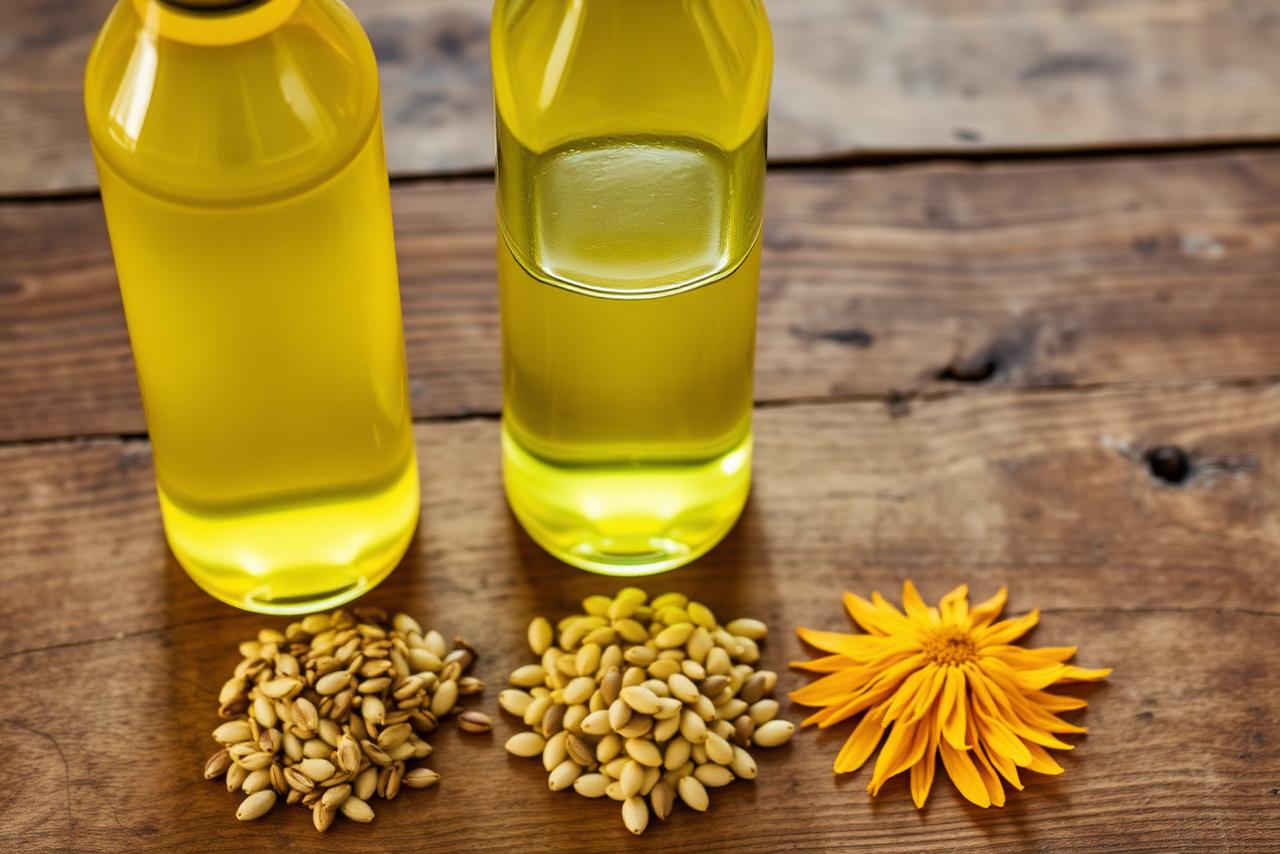
Seed oils are refined vegetable oils extracted from seeds — soybean, sunflower, safflower, corn, canola/rapeseed, cottonseed, grapeseed, and rice bran. They are the most-consumed oils in the industrial food supply. Their health profile is contested online but is broadly favourable in the peer-reviewed literature; the concerns are more about the ultra-processed foods that carry them than the oils themselves.
What are seed oils?
Seed oils are refined vegetable oils extracted from seeds rather than fruits. The main commercial seed oils are soybean, sunflower, safflower, corn, rapeseed (canola in North America), cottonseed, grapeseed, and rice bran. They are typically extracted with a combination of mechanical pressing and hexane solvent extraction, then refined, bleached, and deodorised.
Together they account for the majority of edible oil consumption in industrialised diets and are the default fat in most restaurant frying, industrial baking, salad dressings, mayonnaise, and packaged snacks.
What the evidence actually shows
The mainstream cardiovascular guidance — AHA, WHO, ESC, Cochrane — is that replacing saturated fat with unsaturated fat (including seed oils) lowers cardiovascular events. Key reviews:
- Hooper et al., Cochrane 2020 — replacing saturated fat with polyunsaturated fat reduces cardiovascular events by roughly 17% (moderate certainty).
- Sacks et al., Circulation 2017 — AHA presidential advisory reaffirmed the benefit of replacing saturated fat with polyunsaturated fat.
- Marklund et al., Circulation 2019 pooled analysis of 30 cohorts — higher circulating linoleic acid (the main omega-6 in seed oils) associated with lower cardiovascular mortality.
Where the criticism comes from
The "toxic seed oils" narrative on social media rests on three arguments, each with a scientific kernel and a large amount of extrapolation:
- Omega-6 excess. Modern diets contain more linoleic acid than pre-industrial diets. The extrapolation to systemic inflammation is not supported by controlled human trials.
- Extraction chemistry. Hexane residues in refined oils are within regulatory limits and orders of magnitude below any known toxic threshold.
- Oxidation on reheating. Repeated deep-frying can produce oxidised lipid products; this is a valid concern for commercial fryers, less relevant for home cooking below the smoke point.
The strongest version of the seed-oil critique is not "seed oils are toxic" but "we get most of our seed oils from ultra-processed foods, and those foods are the problem." That framing is compatible with the mainstream evidence and with NOVA.
Practical guidance
- Cooking at home with rapeseed, sunflower, or olive oil is well-supported by the evidence.
- The health risk profile of an industrial snack is dominated by its ingredient system — isolates, emulsifiers, added sugar, sodium — not the seed oil in it.
- If you enjoy olive oil for flavour or for its polyphenol content, use it. If you cook with a refined seed oil for high-heat cooking, that's also fine.
How NakedCalorie treats seed oils
Seed oils appear on ingredient lists as "vegetable oil", "sunflower oil", "rapeseed oil", "canola oil", "soybean oil", or a blend. NakedCalorie does not flag them as a Group 4 marker on their own — they are Group 2 culinary ingredients. The score focuses on the industrial context: emulsifiers, isolates, non-sugar sweeteners, and modified starches. See NOVA Group 2 for the framework's take on cooking oils and hydrogenated oils for the industrial variants that do flag.
Frequently asked questions
- Are seed oils toxic?
- No, not according to any major dietetic body, regulatory agency, or peer-reviewed systematic review. The AHA, WHO, EFSA, and Cochrane reviews all currently support replacing saturated fats with unsaturated seed oils for cardiovascular risk reduction. The 'toxic seed oils' framing is a social-media claim, not a scientific consensus.
- What about the omega-6 to omega-3 ratio?
- Modern Western diets have shifted toward higher omega-6 intake, mainly from linoleic acid in soybean and sunflower oil. Randomised trials (Marklund et al., 2019 pooled analysis; Ramsden 2013) do not show that higher linoleic acid intake raises inflammation markers in humans. The theoretical concern remains debated among researchers but has not translated into a clinical guideline change.
- Are refined and cold-pressed seed oils different?
- Yes, in extraction method, minor-compound content, and flavour. Refined oils use solvents (usually hexane) and high heat; cold-pressed oils are mechanically pressed. Refined oils have a longer shelf life and higher smoke point; cold-pressed oils retain more phenolic compounds. Neither is meaningfully worse for macronutrient composition.
- Do seed oils make a food ultra-processed?
- Not on their own. A bottle of pure refined soybean oil is NOVA Group 2 (a culinary ingredient), not Group 4. What makes a product Group 4 is the industrial formulation the oil is used in — the emulsifiers, isolates, and additives that surround it — not the oil itself.
Written by NakedCalorie editorial team.
Medically reviewed by Pending registered dietitian review — last reviewed July 15, 2026.
Educational information only, based on peer-reviewed literature and regulatory sources. Not medical advice.
Related in the knowledge base
- IngredientsHydrogenated and partially hydrogenated oils
- IngredientsPalm oil
- NOVANOVA Group 2 — processed culinary ingredients