
Dietary fibre
Dietary fibre is the plant carbohydrate the small intestine cannot digest. The IOM sets Adequate Intakes of 25 g/day for adult women and 38 g/day for adult men. Reynolds (Lancet 2019) meta-analysed 185 cohorts and 58 trials showing 15–30% reductions in all-cause and cardiovascular mortality at the top quartile of intake.
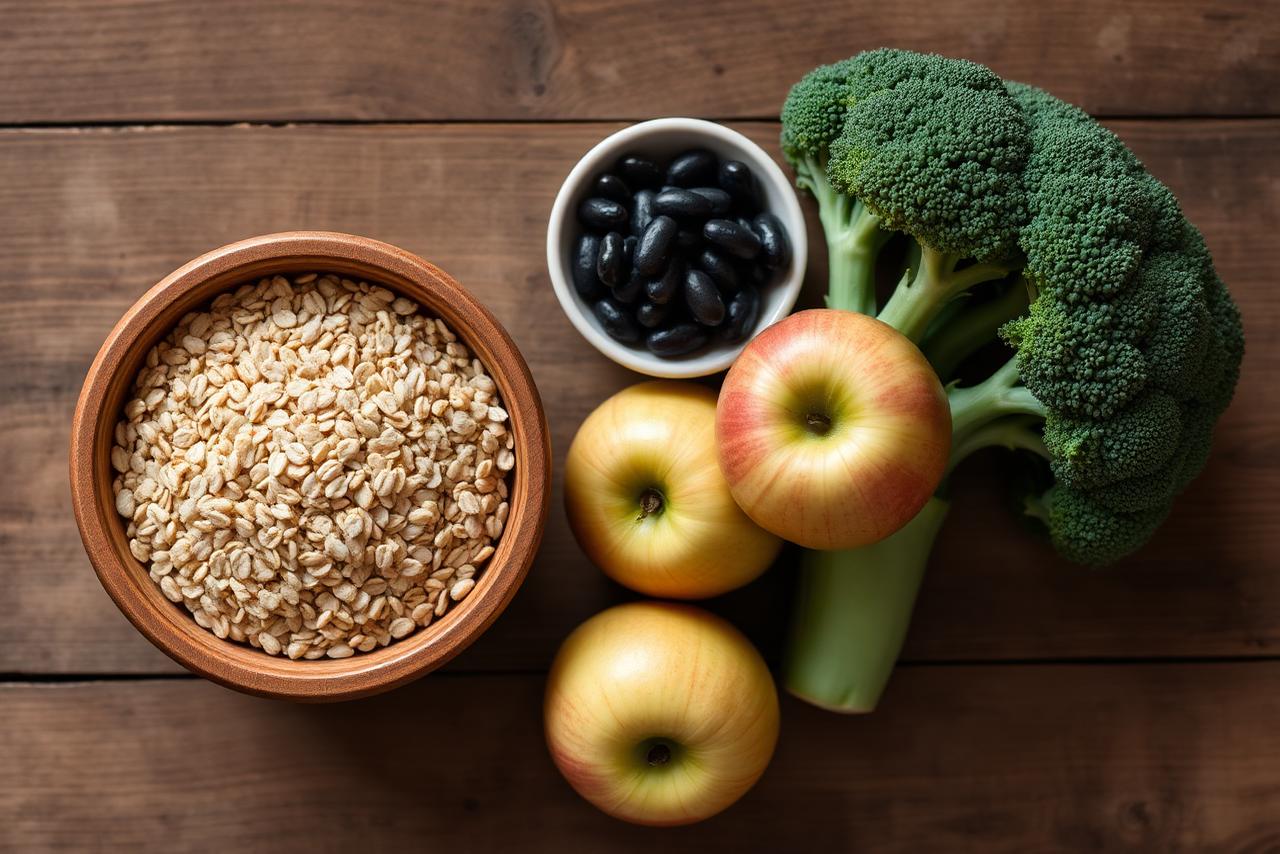
What is dietary fibre?
Dietary fibre is the portion of plant carbohydrate that resists digestion in the small intestine and passes intact into the colon. It is not a single molecule but a family: cellulose, hemicellulose, lignin, pectins, gums, beta-glucans, resistant starches, and inulin-type fructans. The colon ferments the soluble fractions to short-chain fatty acids — acetate, propionate, butyrate — which supply about 2 kcal per gram and act on the gut-brain axis, immune tone, and colonic epithelium.
Intake references
- IOM AI: 25 g/day (women 19–50), 38 g/day (men 19–50); 21 g and 30 g after age 50.
- EFSA: 25 g/day as adequate for adults.
- WHO 2015 update: more than 25 g/day for adults.
- Actual US intake (NHANES 2017–2020): median 16 g/day for women, 19 g/day for men.
The outcome evidence
Reynolds and colleagues (The Lancet 2019;393:434–445) pooled 185 prospective cohort studies and 58 randomised trials. The top-versus-bottom quartile of fibre intake was associated with 15–30% relative reductions in:
| Outcome | Effect (highest vs lowest quartile) |
|---|---|
| All-cause mortality | RR 0.85 (95% CI 0.79–0.91) |
| Cardiovascular mortality | RR 0.77 (0.70–0.85) |
| Type-2 diabetes incidence | RR 0.84 (0.78–0.90) |
| Colorectal cancer incidence | RR 0.84 (0.78–0.89) |
Sources
- Legumes: lentils (~8 g/cup cooked), black beans (~15 g/cup), chickpeas (~12 g/cup).
- Whole grains: oats (~4 g/½ cup dry), barley, whole-wheat pasta.
- Fruit and vegetables: raspberries (~8 g/cup), apples with skin (~4 g), broccoli (~5 g/cup).
- Nuts and seeds: chia (~10 g/oz), flax (~8 g/oz), almonds (~4 g/oz).
Fibre in Group 4 foods
Ultra-processed products often carry an "added fibre" claim built on isolated fibres — chicory root inulin, resistant maltodextrin, polydextrose. These can raise the fibre number on the label without matching the whole-food benefit profile: RCT effects on satiety and cardiometabolic endpoints are weaker for isolated fibres than for intact grains, legumes, and fruit (McRae, Journal of Chiropractic Medicine 2018;17:44–53). See maltodextrin for the sibling ingredient discussion.
How NakedCalorie treats fibre
Fibre grams show in the nutrient panel and, unlike most macronutrients, count positively in the quality signal via the NOVA group: high-fibre whole foods land in Group 1 (whole grains, legumes, fruit), so their score rises through the processing axis, not the fibre number alone. See carbohydrates for the parent macronutrient and Group 1 whole foods for the ingredient pattern.
Frequently asked questions
- How much fibre do adults actually need?
- The IOM Adequate Intake is 25 g/day for women and 38 g/day for men aged 19–50, dropping slightly after age 50. US NHANES data show median intake around 15 g/day — most adults are below target.
- What is the difference between soluble and insoluble fibre?
- Soluble fibre (oat beta-glucan, psyllium, pectin) dissolves in water and forms a gel that slows glucose absorption and lowers LDL. Insoluble fibre (wheat bran, cellulose, most vegetable skins) adds bulk and speeds transit. Whole foods deliver both; supplements usually deliver one.
- Is 'added fibre' on the label the same thing?
- Not always. The FDA restricts the term to seven isolated or synthetic fibres with demonstrated physiological benefit (inulin, psyllium, cellulose, guar, locust bean, hydroxypropyl methylcellulose, pectin). Others — chicory root, resistant maltodextrin, polydextrose — can be counted but with narrower benefit evidence.
- Does fibre reduce colorectal cancer risk?
- Yes. The WCRF/AICR (2018 Continuous Update Project) grades whole-grain and fibre intake as 'probable' protective against colorectal cancer, and the AICR 2024 update raised whole grains to 'convincing' — the highest evidence tier.
- Do I need a fibre supplement?
- Whole foods are the default because they deliver fibre in matrix — with cell walls, phytonutrients, and the resistant starch that feeds the colonic microbiome. Psyllium is the best-evidenced supplement for LDL reduction (Jovanovski, American Journal of Clinical Nutrition 2018;108:922–932) when whole-food targets can't be met.
Written by NakedCalorie editorial team.
Medically reviewed by Pending registered dietitian review — last reviewed July 15, 2026.
Educational information only, based on peer-reviewed literature and regulatory sources. Not medical advice.
Related in the knowledge base
- MacronutrientsCarbohydrates
- MacronutrientsAdded sugar
- NOVANOVA Group 1 — unprocessed and minimally processed foods