
Carbohydrates
Carbohydrates are sugars, starches, and fibre — the macronutrient the body converts fastest to blood glucose. The IOM sets a 130 g/day minimum for adults to cover CNS glucose demand; DGAs 2020–2025 recommend 45–65% of calories from carbohydrate, with quality (whole grains, legumes, fruit) driving cardiometabolic outcomes more than the total.
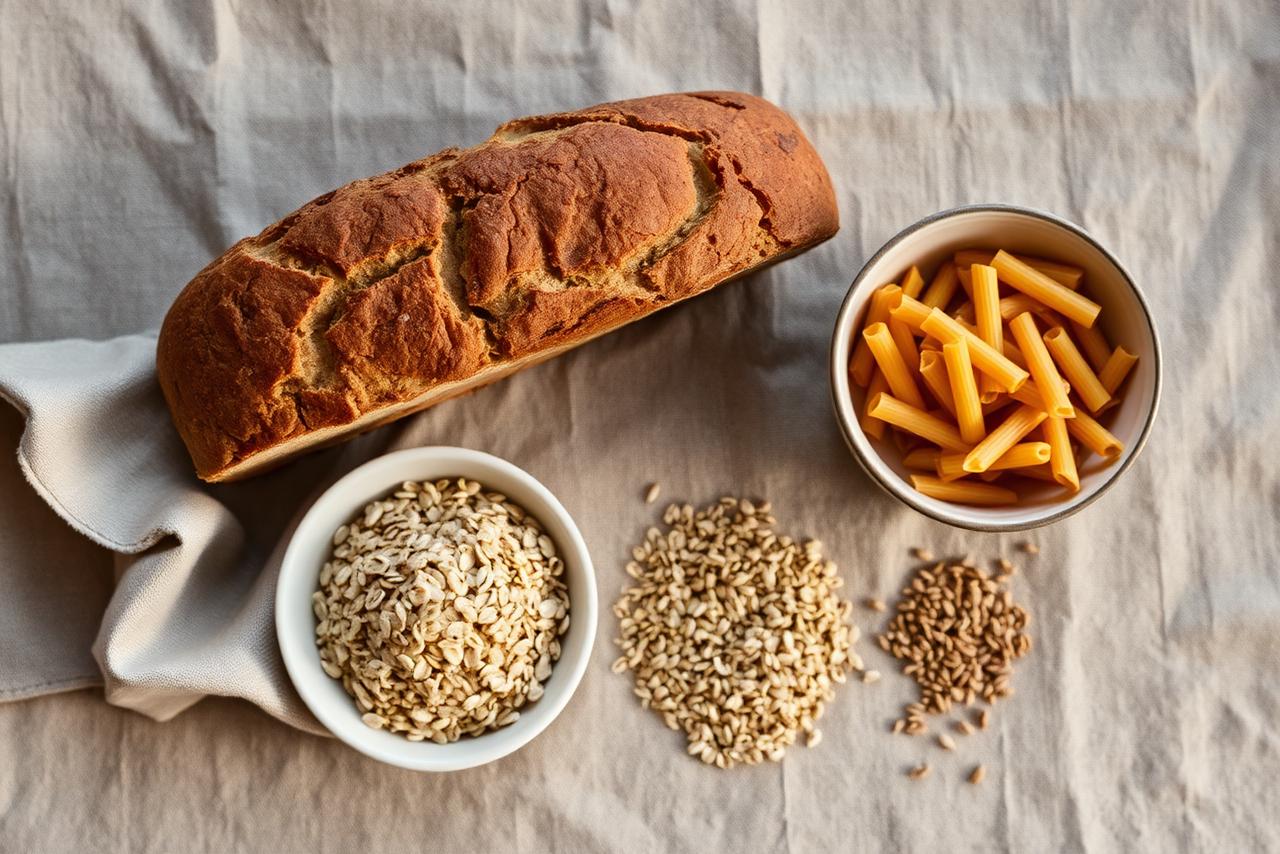
What are carbohydrates?
Carbohydrates are organic compounds of carbon, hydrogen, and oxygen that fall into three dietary buckets: sugars (mono- and disaccharides), starches (glucose polymers digested to sugars), and fibre (polymers the small intestine cannot digest). The digestible fractions deliver 4 kcal per gram; fibre delivers roughly 2 kcal/g through colonic fermentation to short-chain fatty acids.
Intake reference
- IOM RDA: 130 g/day for adults, set to cover central-nervous-system glucose demand.
- Acceptable Macronutrient Distribution Range (AMDR): 45–65% of daily calories.
- WHO 2015 sugars guideline: free sugars below 10% of energy (strong recommendation), below 5% (conditional).
- Fibre target: 25 g/day for adult women, 38 g/day for adult men (IOM AI).
The quality gradient
| Class | Examples | Typical NOVA group |
|---|---|---|
| Whole intact grains | Oats, brown rice, barley, wheat berries | Group 1 |
| Legumes | Lentils, black beans, chickpeas | Group 1 |
| Whole fruit | Apples, berries, bananas | Group 1 |
| Traditional processed | Sourdough bread, plain pasta, tortilla | Group 3 |
| Refined + reformulated | Breakfast cereals, packaged bread, biscuits, energy bars | Group 4 |
| Sweetened beverages | Soda, sports drinks, sweetened tea, most juices | Group 4 |
What the evidence says about carbohydrate quality
Reynolds and colleagues (The Lancet 2019;393:434–445) pooled 185 prospective studies and 58 clinical trials on carbohydrate quality, finding a 15–30% reduction in all-cause mortality, cardiovascular incidence, type-2 diabetes, and colorectal cancer when participants moved from the lowest to highest quartile of dietary fibre or whole-grain intake. The signal for total carbohydrate share was weak; the signal for fibre and grain integrity was strong and consistent.
The PURE cohort (Dehghan, Lancet 2017;390:2050–2062) reported higher mortality with very high (>75%) carbohydrate intake, but the effect was concentrated in low-income settings dominated by refined-rice diets — a quality story, not a total-carb story. The Group 4 exposure signal from the umbrella review (Lane, BMJ 2024;384:e077310) subsumes most of the "refined-carb" epidemiology.
How NakedCalorie treats carbohydrates
Grams and percent of calories from carbohydrate are shown in the nutrient panel but do not move the score. What moves the score is the NOVA group, the presence of added sugar, the fibre density, and any Group 4 ingredient markers (high-fructose corn syrup, maltodextrin, protein isolates, cosmetic additives). See fibre for the quality lever that actually matters.
Frequently asked questions
- Is there a required daily minimum for carbohydrate?
- The IOM DRI (2005) sets an RDA of 130 g/day for adults, defined as the amount needed to fuel the central nervous system without relying on ketogenesis. Intakes below that are not deficient in the classical sense — the liver produces glucose via gluconeogenesis — but the DRI is the reference for planned diets.
- Do low-carb diets work?
- For weight loss over 6–12 months, meta-analyses (Naude, PLOS ONE 2014; Ge, BMJ 2020) show low-carb and low-fat diets converge to within 1–2 kg of each other when protein is matched. What consistently predicts outcome is adherence and diet quality, not carbohydrate share.
- What is glycemic index and does it matter?
- Glycemic index (GI) ranks how quickly a food raises blood glucose relative to pure glucose. It is useful for meal planning in type 2 diabetes and for endurance sport, but for general adults the whole-food, fibre, and NOVA-group signal outperforms GI as a predictor of cardiometabolic risk (Reynolds, Lancet 2019;393:434–445).
- What is a 'refined' carbohydrate?
- A grain whose bran and germ have been milled out — leaving mostly endosperm starch and losing 60–90% of its fibre, magnesium, potassium, and B-vitamin content. Most Group 4 bakery, breakfast, and snack products are built on refined flour plus added sugar and emulsifiers.
- Is fruit sugar bad?
- No. Whole fruit is a Group 1 food; the fibre matrix slows glucose absorption and epidemiology (Aune, International Journal of Epidemiology 2017;46:1029–1056) associates 2–3 servings/day with lower all-cause mortality. Fruit juice — which loses the matrix — behaves closer to a sweetened beverage in cohort data.
Written by NakedCalorie editorial team.
Medically reviewed by Pending registered dietitian review — last reviewed July 15, 2026.
Educational information only, based on peer-reviewed literature and regulatory sources. Not medical advice.
Related in the knowledge base
- MacronutrientsDietary fibre
- MacronutrientsAdded sugar
- NOVANOVA Group 4 — ultra-processed foods