
Protein
Protein is the macronutrient that supplies the amino acids the body uses to build tissue, produce enzymes and hormones, and mount the immune response. It delivers 4 kcal per gram. The US RDA is 0.8 g/kg body weight per day; muscle-, older-adult-, and weight-loss-preservation meta-analyses now support 1.2–2.0 g/kg for better outcomes in those contexts.
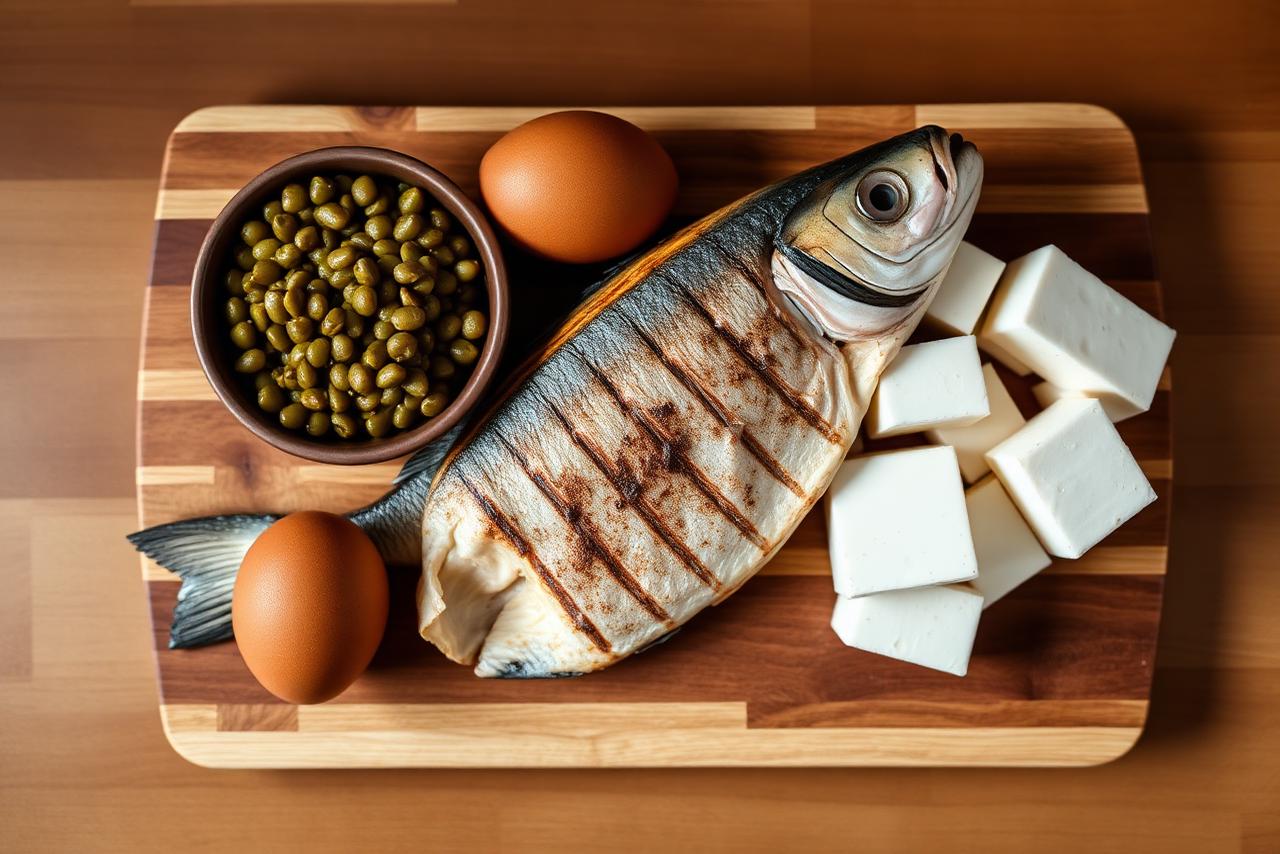
What is protein?
Protein is a polymer of amino acids folded into a functional shape by the sequence of its constituent residues. Nine of the twenty proteinogenic amino acids are essential — the body cannot synthesise them and must obtain them from food. In dietary terms, protein delivers 4 kcal per gram and supplies the nitrogen the body uses to build muscle, connective tissue, enzymes, and antibodies, and to keep the plasma amino-acid pool from being depleted between meals.
How much do you need?
| Population / goal | Recommendation | Source |
|---|---|---|
| Sedentary adult (US) | 0.8 g/kg/day | IOM DRI 2005 |
| Sedentary adult (EU) | 0.83 g/kg/day (PRI) | EFSA 2012 |
| Adults over 65 | 1.0–1.2 g/kg/day | PROT-AGE (Bauer 2013) |
| Resistance training | 1.6–2.2 g/kg/day | Morton 2018 meta-analysis |
| Weight loss (energy deficit) | 1.6–2.4 g/kg/day | Helms 2014; Longland 2016 |
The RDA is a floor, not a target — it is the intake at which about 97.5% of the population will avoid negative nitrogen balance. The higher numbers in trained, older, or dieting adults reflect measurably better outcomes on function-level endpoints (lean mass retention, strength, gait speed), not just nitrogen balance.
Where protein comes from
- Animal foods: meat, poultry, fish, eggs, dairy. Complete amino-acid profiles, high digestibility (DIAAS > 1.0 for most cuts and dairy).
- Legumes and pulses: beans, lentils, chickpeas, soy, edamame. Lower in methionine than animal foods but paired with grains across the day the shortfall closes.
- Whole grains, nuts, seeds: secondary contributors; higher in lysine when combined with legumes.
- Manufactured isolates: whey, casein, soy, pea, rice, hemp protein isolates. Grams of protein per calorie are unmatched, and they are the archetypal NOVA Group 4 ingredient.
Distribution and quality
Muscle protein synthesis peaks around 0.3–0.4 g/kg per meal (Moore, American Journal of Clinical Nutrition 2009;89:161–168; Schoenfeld & Aragon 2018). Spreading intake across three or four meals of that size beats loading it into one large dinner, particularly in adults over 60 where "anabolic resistance" raises the per-meal threshold.
Quality is captured by two measures: PDCAAS (older, capped at 1.0) and the newer DIAAS published by the FAO (2013 report on Protein Quality Evaluation). Whole milk, egg, whey, and soy isolate score at or above 1.0; wheat, rice, and most single plant sources score 0.4–0.9 in isolation but rise sharply in mixed diets.
Protein in ultra-processed foods
Because isolates are cheap and functionally flexible, "high-protein" packaging usually signals a Group 4 formulation: bars, shakes, snack puffs, protein cereals. These products meet the macronutrient number on the label but arrive with emulsifiers, sweeteners, and flavour systems — the same additive profile Monteiro (2019) uses to identify UPF. The Hall randomised feeding trial (Cell Metabolism 2019;30:67–77) showed that even calorie- and protein-matched UPF diets drove +508 kcal/day of spontaneous intake versus a whole-food comparator.
How NakedCalorie treats protein
Absolute protein content is not scored directly — a food does not get a higher score for being "high protein". Protein-isolate ingredients on the label do count toward NOVA Group 4 classification. See protein isolates for the ingredient-level view, carbohydrates and dietary fats for the other macros, and Group 4 ultra-processed foods for why the formulation matters more than the protein number.
Frequently asked questions
- How much protein do I actually need?
- The US RDA set by the Institute of Medicine is 0.8 g per kg of body weight per day, enough to prevent frank deficiency in a sedentary adult. Meta-analyses on resistance training (Morton, British Journal of Sports Medicine 2018;52:376–384), aging (Bauer, JAMDA 2013;14:542–559), and weight-loss preservation converge on 1.2–2.0 g/kg for better long-term outcomes in those contexts.
- Are plant proteins as good as animal proteins?
- For meeting total daily amino-acid requirements, yes, if the diet is varied. Any single plant source has a less balanced amino-acid profile than a mixed animal source, but combined intake across a day (legumes, grains, seeds, soy) matches or exceeds requirements. Soy, quinoa, buckwheat, and mycoprotein are individually 'complete'.
- What are protein isolates and why are they flagged?
- Isolates are concentrated protein fractions — whey, soy, pea, casein — extracted from a whole food. They are functional ingredients for shakes, bars, and 'high-protein' packaged foods, and they are one of the ingredient markers Monteiro et al. (Public Health Nutrition 2019;22:936–941) use to classify a product as NOVA Group 4.
- Can you eat too much protein?
- For healthy kidneys, intakes up to 2 g/kg/day are well tolerated across long-term studies (Devries, Journal of Nutrition 2018;148:1760–1775). Very high intakes tend to displace fibre and carbohydrate sources — the practical trade-off is usually diet quality, not toxicity.
- Does timing matter (the 'anabolic window')?
- Total daily protein and distribution across 3–4 meals of 0.3–0.4 g/kg matter more than the narrow post-workout window suggested by early studies. Schoenfeld and Aragon (Journal of the International Society of Sports Nutrition 2018;15:10) reviewed 23 trials and found no advantage for consumption inside a 1-hour post-training window when daily protein was matched.
Written by NakedCalorie editorial team.
Medically reviewed by Pending registered dietitian review — last reviewed July 15, 2026.
Educational information only, based on peer-reviewed literature and regulatory sources. Not medical advice.
Related in the knowledge base
- IngredientsProtein isolates (whey, soy, pea)
- MacronutrientsCarbohydrates
- MacronutrientsDietary fats