
Omega-3 vs omega-6
Omega-3 and omega-6 are the two essential polyunsaturated fatty acid families the body cannot make. EFSA sets an adequate intake of 250 mg/day EPA + DHA for adults; the ratio debate (typical Western diets are 10–20:1 omega-6 to omega-3) is contested because most RCT and cohort evidence favours higher, not lower, linoleic acid intake for cardiovascular outcomes.
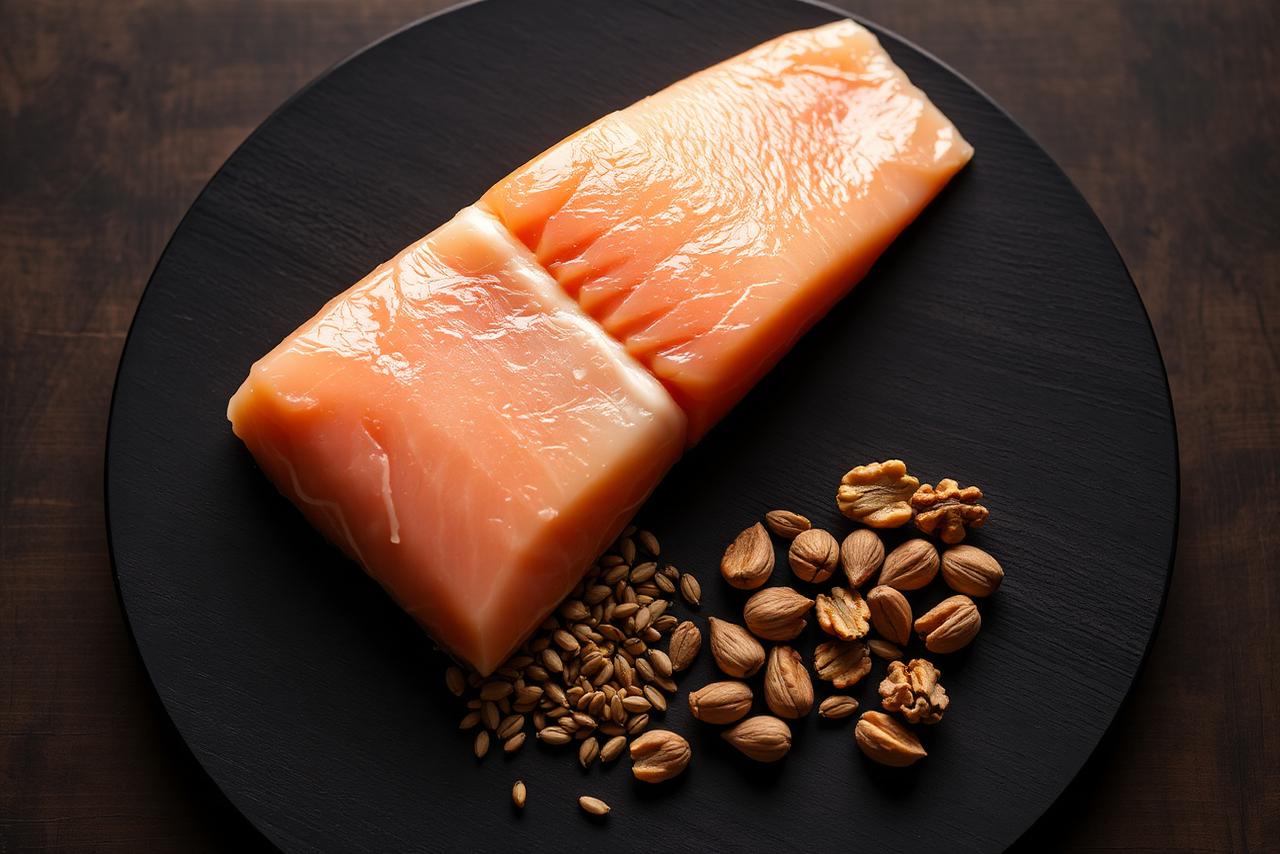
What are omega-3 and omega-6?
Omega-3 and omega-6 are the two families of polyunsaturated fatty acids the human body cannot synthesise and must obtain from food. The names describe the position of the first double bond counted from the methyl (omega) end of the chain — three carbons in for omega-3, six carbons in for omega-6. Both are essential, both are polyunsaturated, both are used to build cell-membrane phospholipids and to produce eicosanoid signalling molecules.
The key members
| Family | Fatty acid | Main food sources |
|---|---|---|
| Omega-3 | ALA (18:3) | Flax, chia, walnuts, canola oil |
| Omega-3 | EPA (20:5) | Salmon, sardines, mackerel, anchovies, algae oil |
| Omega-3 | DHA (22:6) | Salmon, sardines, mackerel, algae oil, egg yolks (small) |
| Omega-6 | LA (18:2, linoleic acid) | Sunflower, safflower, corn, soybean oil; nuts and seeds |
| Omega-6 | AA (20:4, arachidonic acid) | Meat, poultry, eggs |
Intake references
- EFSA: 250 mg/day EPA + DHA for adults; 100–200 mg/day DHA during pregnancy.
- AHA (Rimm 2018): two servings of non-fried oily fish per week.
- IOM AI for ALA: 1.6 g/day (men), 1.1 g/day (women).
- IOM AI for LA: 17 g/day (men), 12 g/day (women).
The ratio debate
The 10–20:1 omega-6 to omega-3 ratio in typical Western diets is often contrasted with an estimated 1:1 ratio in ancestral diets (Simopoulos, Biomedicine & Pharmacotherapy 2002;56:365–379). The ratio hypothesis says that too much omega-6 crowds omega-3 out of the eicosanoid pathway and pushes signalling toward inflammation. The RCT and cohort record does not agree:
- Farvid et al. (Circulation 2014;130:1568–1578) pooled 13 cohorts and found each 5% of energy from LA associated with 9% lower CHD events.
- Marklund et al. (Circulation 2019;139:2422–2436) pooled 30 cohorts on circulating fatty acids and reported LA in the highest tertile linked to lower CVD mortality (HR 0.83) and lower diabetes incidence.
- Johnson & Fritsche (Journal of the Academy of Nutrition and Dietetics 2012;112:1029–1041) reviewed 15 randomised feeding trials on LA and inflammatory markers: no effect on CRP, IL-6, TNF-α at doses spanning typical intakes.
The practical implication: the well-supported target is enough EPA + DHA (fish or algae), not cutting linoleic acid. What is fair to say is that most omega-6 in the modern food supply is delivered inside Group 4 formulations, so the exposure is often bundled with everything else that comes with UPF.
How NakedCalorie treats omega-3 and omega-6
Individual fatty acid amounts are not on most label panels and are not scored directly. The app treats refined seed oils as a NOVA marker where they appear as functional filler, not as a nutrient-density hit. Whole-food sources of both families — oily fish, walnuts, flax, olive oil — sit in Group 1 and lift the score through the processing axis. See dietary fats for the parent overview.
Frequently asked questions
- What is the difference between ALA, EPA, and DHA?
- ALA (alpha-linolenic acid, 18:3) is the plant-form omega-3 in flax, chia, and walnuts. EPA (20:5) and DHA (22:6) are the long-chain marine forms in oily fish and algae — the forms clinical trials use. Conversion of ALA to EPA/DHA in humans is inefficient (5–8% for EPA, <1% for DHA), which is why 'get your omega-3 from flax' understates the target.
- How much omega-3 should I eat?
- EFSA sets an adequate intake of 250 mg/day EPA + DHA for adults, rising to 100–200 mg/day of DHA in pregnancy. The AHA recommends two servings of fatty fish per week (Rimm, Circulation 2018;138:e35–e47). REDUCE-IT (Bhatt, NEJM 2019;380:11–22) used 4 g/day of icosapent ethyl in secondary CVD prevention — a therapeutic, not dietary, dose.
- Is the omega-6 to omega-3 ratio the important number?
- In vitro yes — arachidonic acid (from omega-6) and EPA compete for the same enzymes and produce eicosanoids with opposing signalling. In humans the ratio underperforms absolute EPA + DHA intake as an outcome predictor. Marklund et al. (Circulation 2019;139:2422–2436) pooled 30 cohorts and found higher circulating linoleic acid — the dominant omega-6 — associated with lower CVD mortality.
- Are seed oils inflammatory?
- Linoleic acid is the precursor of arachidonic acid, which yields pro-inflammatory eicosanoids. But at typical dietary intakes it does not raise circulating CRP or IL-6 in controlled trials (Johnson & Fritsche, Journal of the Academy of Nutrition and Dietetics 2012;112:1029–1041). The 'seed oils are inflammatory' claim is a mechanistic extrapolation the human data do not support.
- Should I take a fish-oil supplement?
- For primary prevention, meta-analyses (Aung, JAMA Cardiology 2018;3:225–234) show no clear benefit at typical dietary doses (~1 g/day). For secondary prevention at high dose (REDUCE-IT, 4 g/day icosapent ethyl), the number-needed-to-treat was 21 over 5 years. Whole-food fish remains the cleanest dietary source.
Written by NakedCalorie editorial team.
Medically reviewed by Pending registered dietitian review — last reviewed July 15, 2026.
Educational information only, based on peer-reviewed literature and regulatory sources. Not medical advice.
Related in the knowledge base
- MacronutrientsDietary fats
- MacronutrientsSaturated vs unsaturated fat
- IngredientsSeed oils — the industrial vegetable oils debate