
Zinc
Zinc is the essential trace mineral in more than 300 enzymes and the structural motif in thousands of DNA-binding proteins. The IOM RDA is 11 mg/day for adult men and 8 mg/day for adult women. The EFSA UL is 25 mg/day for adults; the IOM UL is 40 mg/day. Bioavailability is markedly lower from high-phytate plant diets, and vegetarians are advised a higher intake target.
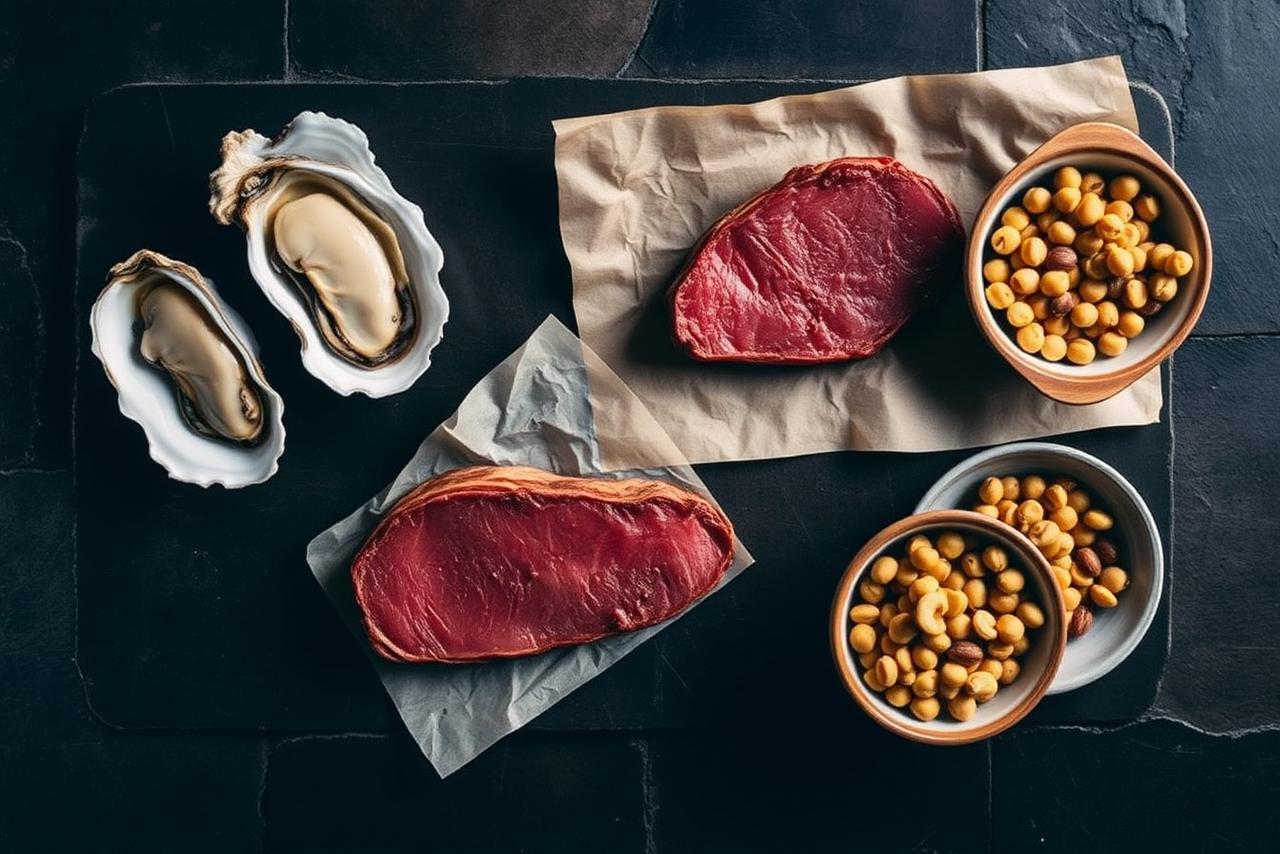
What zinc does
Zinc is a catalytic, structural, or regulatory cofactor for more than 300 enzymes and is the structural motif in an estimated 10% of human proteins — the "zinc finger" DNA-binding domains that regulate transcription across nearly every gene network. Zinc supports antibody and T-cell function, wound healing, testosterone synthesis, taste perception, and normal growth. Frank deficiency in children causes growth retardation and recurrent infection; sub-clinical inadequacy in adults presents as slow wound healing and blunted immune response.
Intake references
- IOM RDA: 11 mg/day (men), 8 mg/day (women); 11 mg pregnancy; 12 mg lactation.
- EFSA PRI: 9.4–16.3 mg/day (men), 7.5–12.7 mg/day (women), phytate-adjusted.
- UL (IOM): 40 mg/day for adults, from all sources including supplements.
- UL (EFSA): 25 mg/day for adults.
Sources
| Food | Zinc (mg) | Notes |
|---|---|---|
| Oysters (3 oz cooked) | 32 | Densest food source known |
| Beef (3 oz cooked) | 7 | High bioavailability |
| Pumpkin seeds (1 oz) | 2.2 | Lower absorption than animal sources |
| Lentils, cooked (1 cup) | 2.5 | Soak or sprout to reduce phytate |
| Chickpeas, cooked (1 cup) | 2.5 | Same phytate consideration |
| Cashews (1 oz) | 1.6 | |
| Yoghurt (1 cup) | 1.7 | Well absorbed |
| Fortified breakfast cereal (1 serving) | 3.8 | Group 4 vehicle; source declared on label |
Bioavailability and diet pattern
The IZiNCG (International Zinc Nutrition Consultative Group; Food and Nutrition Bulletin 2004;25 Suppl:S99–S203) classifies mixed diets into three phytate-load groups and adjusts requirements accordingly. In practice, the biggest single lever for adults on a high-phytate whole-food diet is not eating more zinc but preparing legumes and whole grains in ways that lower phytate (soaking, sprouting, sourdough fermentation of grains).
Zinc in the immune system
Wessels, Maywald, and Rink (Nutrients 2017;9:1286) reviewed the mechanistic base for zinc's role in innate and adaptive immunity: thymic hormone production, cytokine balance, T- and B-cell development, and macrophage function all depend on adequate zinc status. This is the biology behind the lozenge trials — high local zinc concentrations in the pharynx blunt rhinovirus replication.
How NakedCalorie treats zinc
Zinc is shown per serving in mg on the nutrient panel where declared. Fortified zinc in a Group 4 formulation does not raise the food-quality score. See iron for the trace mineral with the largest global deficiency footprint and protein for the whole-food source pattern that also delivers zinc.
Frequently asked questions
- How much zinc do adults need?
- The IOM RDA is 11 mg/day for men and 8 mg/day for women (11 mg during pregnancy, 12 mg during lactation). EFSA sets population reference intakes of 9.4–16.3 mg/day for men and 7.5–12.7 mg/day for women, scaled by dietary phytate load.
- How does phytate affect absorption?
- Phytate (inositol hexaphosphate) in whole grains and legumes chelates zinc in the gut. Molar phytate:zinc ratios above 15 reduce absorption sharply. Soaking, sprouting, fermenting (sourdough), and cooking legumes reduce phytate content; a mixed diet with animal foods offsets the effect.
- Do vegetarians need more zinc?
- Yes. The IOM notes that requirements for adults consuming only plant-based diets may be as much as 50% higher than the standard RDA because of reduced bioavailability, though 'as high as' is a ceiling rather than a routine target.
- Do zinc lozenges shorten a cold?
- Zinc acetate or gluconate lozenges (≥ 75 mg/day of elemental zinc, started within 24 hours of symptom onset) reduce common-cold duration by roughly 1–2 days in Cochrane and JAMA reviews (Hemilä, Journal of the Royal Society of Medicine 2017;110:281–288). Adverse effects (nausea, dysgeusia) are common at that dose.
- Can zinc supplementation backfire?
- Chronic supplemental zinc above 40 mg/day (the IOM UL) can precipitate copper deficiency by inducing intestinal metallothionein and reducing copper absorption. High-dose zinc supplementation without medical supervision is inadvisable.
Written by NakedCalorie editorial team.
Medically reviewed by Pending registered dietitian review — last reviewed July 15, 2026.
Educational information only, based on peer-reviewed literature and regulatory sources. Not medical advice.
Related in the knowledge base