
Potassium
Potassium is the principal intracellular cation and the counter-ion to sodium in blood-pressure regulation. The IOM Adequate Intake is 3,400 mg/day for adult men and 2,600 mg/day for adult women; the WHO recommends at least 3,510 mg/day. Median intake in the US and Europe is well below target.
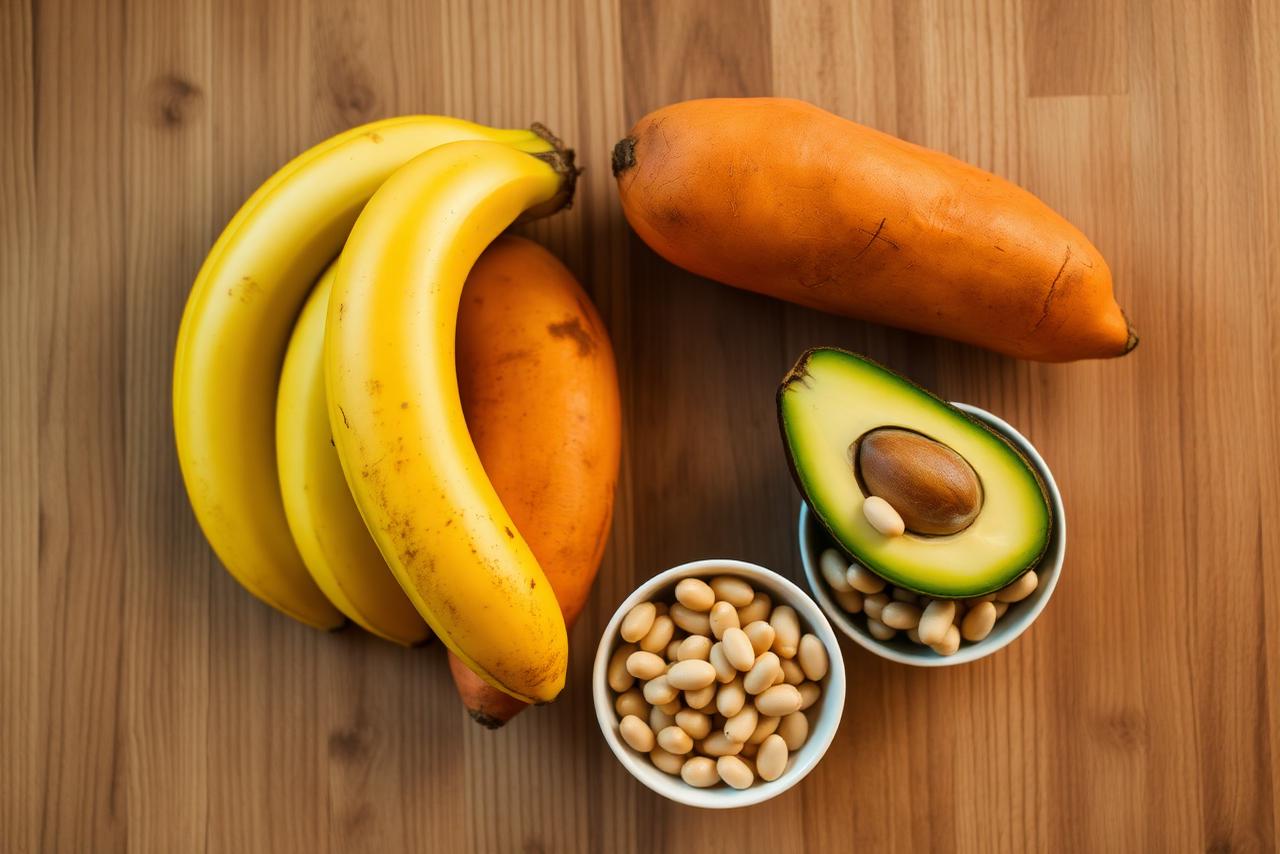
What potassium does
Potassium is the principal cation of intracellular fluid — the body holds about 140 g, almost all inside cells. Along with sodium it maintains the membrane potential that drives nerve conduction, muscle contraction, and cardiac electrical activity. On the cardiovascular side, potassium acts as the counter-ion to sodium: higher intake promotes natriuresis, reduces vascular resistance, and blunts the blood-pressure effect of a sodium load.
Intake references
- IOM AI (2019): 3,400 mg/day (men), 2,600 mg/day (women).
- WHO: at least 3,510 mg/day for adults.
- EFSA AI: 3,500 mg/day for adults.
- UL: not established (whole-food intake is not hazardous in adults with normal renal function).
Where potassium concentrates
| Food | Potassium (mg) |
|---|---|
| White beans, cooked (1 cup) | 1,000 |
| Baked potato with skin (medium) | 950 |
| Cooked spinach (1 cup) | 840 |
| Lentils, cooked (1 cup) | 730 |
| Sweet potato (medium) | 540 |
| Avocado (half) | 490 |
| Banana (medium) | 420 |
| Yoghurt (1 cup) | 380 |
| Salmon (3 oz) | 330 |
Cardiovascular evidence
The DASH trials (Appel, NEJM 1997;336:1117–1124) demonstrated that a potassium-rich, fibre-rich, low-sodium eating pattern lowered systolic blood pressure by 11 mmHg in adults with hypertension over 8 weeks. Aburto's 2013 BMJ meta-analysis (33 RCTs) reported a 24% reduction in stroke incidence with higher habitual potassium intake. The SSaSS RCT (Neal 2021), described in more detail under sodium, delivered its stroke and CV mortality benefit by adding potassium to the salt shaker.
Why intake is so far off target
Potassium concentrates in unprocessed and minimally processed foods. The Group 4 food supply provides very little of it per calorie — processing steps designed to add shelf life (drying, refining, extrusion) and cheap functional ingredients (sugars, starches, refined oils) displace potassium-dense whole foods from the plate. This is one of several nutrient gaps that a whole-food-forward pattern closes without needing supplementation.
How NakedCalorie treats potassium
Potassium is shown per serving in mg and as % Daily Value (4,700 mg reference on the current label) where declared. Because most whole-food potassium concentrates in Group 1 foods, the NOVA-group signal already tracks it closely. See sodium for the counterpart mineral in blood-pressure regulation.
Frequently asked questions
- How much potassium do adults need?
- The IOM 2019 update sets Adequate Intakes of 3,400 mg/day for men and 2,600 mg/day for women, revised down from the previous 4,700 mg based on stronger evidence review. The WHO recommends at least 3,510 mg/day for cardiovascular benefit. NHANES data show US median intake around 2,300 mg/day for women and 3,000 mg/day for men — most adults are short.
- Does potassium really lower blood pressure?
- Yes. Aburto and colleagues (BMJ 2013;346:f1378) pooled 33 RCTs and reported that raising potassium intake by ~2 g/day reduced systolic blood pressure by 3–4 mmHg overall and 5–7 mmHg in adults with hypertension. The SSaSS RCT (Neal, NEJM 2021;385:1067–1077) added potassium chloride to salt and reduced stroke by 14%.
- Which foods are best?
- Baked potato with skin (~950 mg), white beans (~1,000 mg/cup cooked), lentils (~730 mg/cup), sweet potato (~540 mg medium), banana (~420 mg), avocado (~490 mg/half), spinach (~840 mg/cup cooked), yoghurt (~380 mg/cup). Whole foods — the reason DASH-pattern diets work so well.
- Can you get too much potassium?
- From food alone in healthy adults, essentially never — the kidneys excrete the excess. Supplementation carries real risk, particularly in adults with chronic kidney disease, adults on ACE inhibitors or ARBs, and adults on potassium-sparing diuretics. The IOM did not set a UL for adults because whole-food intake is not hazardous.
- Do salt substitutes work?
- For adults without CKD, potassium-enriched salt substitutes (typically 25% KCl / 75% NaCl) reduce blood pressure and cardiovascular events (SSaSS 2021). They must be avoided in people with impaired renal function.
Written by NakedCalorie editorial team.
Medically reviewed by Pending registered dietitian review — last reviewed July 15, 2026.
Educational information only, based on peer-reviewed literature and regulatory sources. Not medical advice.
Related in the knowledge base
- MicronutrientsSodium
- MicronutrientsMagnesium
- MacronutrientsDietary fibre