
Front-of-pack labels
A front-of-pack (FOP) label is a summary indicator printed on the principal display panel of a food package to help consumers judge overall nutritional quality at a glance. Prominent schemes include the UK traffic-light system, the French Nutri-Score (now used across several EU countries), the Chilean black-octagon warning labels, and the FDA's proposed 2024 US front-of-pack scheme.
What FOP labels are
Front-of-pack labels are simplified nutrition summaries printed on the front of a food package to guide quick purchase decisions. The Nutrition Facts panel and the EU nutrition declaration require a mandatory, detailed table on the back or side; FOP schemes complement that with a single-glance signal.
Major schemes
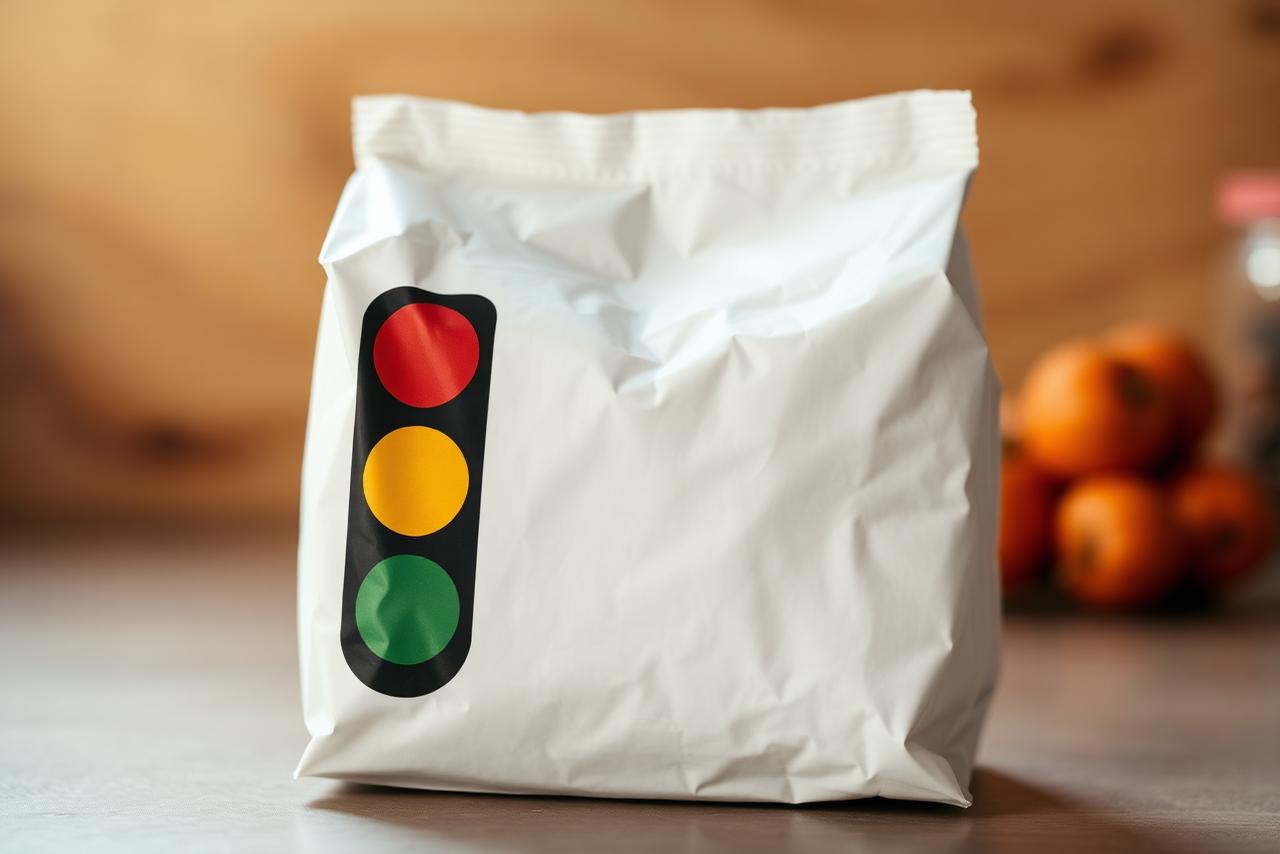
- UK traffic lights (voluntary, 2013) — red/amber/green for fat, saturated fat, sugars, salt per 100 g and per portion.
- Nutri-Score (France 2017; Belgium, Netherlands, Germany, Luxembourg, Spain, Switzerland adopters) — five-tier A–E colour scale based on 2023 algorithm.
- Chilean warning octagons (mandatory 2016) — black octagons for products exceeding thresholds on sugar, saturated fat, sodium, or calories.
- Australia/NZ Health Star Rating (voluntary 2014) — half-star to five-star rating.
- Nutrinform Battery (Italy) — battery-style icons for energy and four nutrients per portion.
- US FDA proposal 2024 — mandatory 'Low / Medium / High' descriptors for saturated fat, sodium, added sugars.
Evidence base
Randomised trials (Ares 2020, Egnell 2018) and quasi-experimental studies (Chile natural experiment, Nutri-Score in France) consistently show that FOP labels improve consumers' ability to rank products by healthiness and shift a small but measurable fraction of purchases toward better-scoring options. Warning-style schemes (octagons) outperform summary-star schemes on comprehension.
How NakedCalorie relates to FOP schemes
The NakedCalorie score is closer in spirit to the FDA 2024 proposal and Nutri-Score than to a NOVA-only classification: it combines nutrient thresholds with a processing signal. See NOVA vs Nutri-Score for how the two signals compare.
Frequently asked questions
- How is Nutri-Score calculated?
- It scores products on positive components (fibre, protein, fruit/vegetable/legume content) and negative components (energy, saturated fat, sugars, sodium) per 100 g, then maps the net score to a five-tier scale from dark-green A to dark-red E. The 2023 algorithm update tightened treatment of red meat, poultry, sugar-sweetened beverages, and whole grains.
- Does Nutri-Score account for processing?
- No — that is its main criticism. A reformulated ultra-processed product with lower sugar and higher fibre can outscore a whole-food alternative. This is why NOVA proponents argue Nutri-Score and a processing classification are complementary, not substitutes. See our NOVA vs Nutri-Score article.
- What are Chile's warning octagons?
- Since 2016, Chile has required black octagons stating 'HIGH IN' — sugar, saturated fat, sodium, or calories — on any product exceeding published thresholds. Peru, Mexico, Uruguay, and Argentina have adopted variations. Trials show they reduce purchase of flagged products.
- What is the FDA doing?
- In August 2024 the FDA published a proposed rule for a mandatory front-of-pack nutrition label focused on saturated fat, sodium, and added sugars with 'Low', 'Medium', and 'High' descriptors. The final rule and compliance date are not yet set.
Written by NakedCalorie editorial team.
Medically reviewed by Pending registered dietitian review — last reviewed July 15, 2026.
Educational information only, based on peer-reviewed literature and regulatory sources. Not medical advice.
Related in the knowledge base
- Food labelingThe Nutrition Facts panel (US)
- Food labelingThe EU nutrition declaration
- NOVANOVA vs Nutri-Score — what each one measures