
The Nutrition Facts panel (US)
The Nutrition Facts panel is the standardised nutrient declaration required on most packaged foods sold in the United States, defined by 21 CFR 101.9. Its current format — updated in 2016 and required on all packages since 2021 — lists Serving Size, Calories, Total and Saturated Fat, Sodium, Total Carbohydrate, Fibre, Total Sugars and Added Sugars, Protein, and %DV for vitamin D, calcium, iron, and potassium.
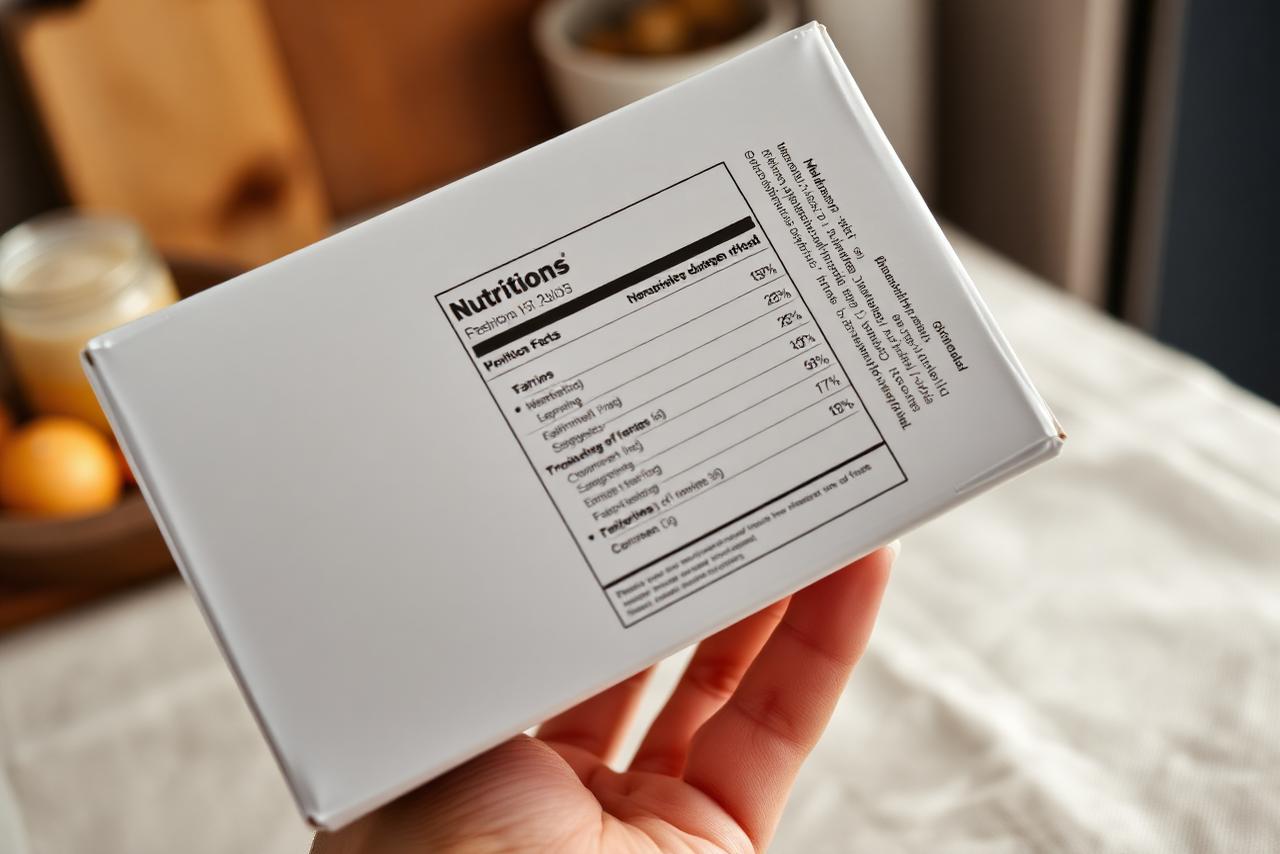
What the Nutrition Facts panel is
The Nutrition Facts panel is the FDA-mandated nutrient declaration on packaged food sold in the United States. Its current format is defined by 21 CFR 101.9, was updated in a major revision published in May 2016, and has been required on all packages since 1 January 2021 (delayed compliance for very small manufacturers). USDA-regulated foods (meat, poultry, egg products) follow a parallel rule (9 CFR 317.309) with equivalent content.
What is on the panel
- Serving size — expressed in a common household measure and in grams/mL, based on Reference Amounts Customarily Consumed (RACCs).
- Servings per container.
- Calories per serving — larger typeface than in the pre-2016 format.
- Total Fat, Saturated Fat, Trans Fat — grams and %DV.
- Cholesterol, Sodium — mg and %DV.
- Total Carbohydrate, Dietary Fibre, Total Sugars, Added Sugars — g and %DV (Added Sugars was new in 2016).
- Protein — g. %DV only required when a protein claim is made or the food is intended for children under 4.
- Vitamin D, Calcium, Iron, Potassium — the four micronutrients required in the 2016 revision (replacing the previously required vitamins A and C).
What changed in 2016
| Change | Old | New (2016) |
|---|---|---|
| Serving size (ice cream) | ½ cup | ⅔ cup |
| Added Sugars line | Not required | Required, with %DV |
| Required micronutrients | Vitamins A, C, calcium, iron | Vitamin D, calcium, iron, potassium |
| Calorie display | Standard type | Large, bold |
| Sodium DV | 2,400 mg | 2,300 mg |
Reading the panel
Serve first: read the serving size and compare with what you actually eat. Then check Calories and %DV. 5% DV or less is "low"; 20% DV or more is "high". Added Sugars over 10% DV means the product contributes meaningfully to the WHO free-sugar ceiling. Sodium over 20% DV in a single serving is a red flag for adults with hypertension or salt-sensitive blood pressure.
What the panel does not tell you
The Nutrition Facts panel is silent on food-processing degree — a Group 4 formulation engineered to hit the exact same nutrients as a Group 1 whole food would look identical on the panel, and the ingredient list is where the difference appears. This is why the panel is necessary but insufficient, and why NakedCalorie surfaces the NOVA classification alongside the panel numbers. See the EU nutrition declaration for the equivalent in Europe and front-of-pack schemes for summary indicators.
Frequently asked questions
- Why did Serving Size change in 2016?
- The FDA updated Reference Amounts Customarily Consumed (RACCs) to reflect actual eating patterns. A serving of ice cream went from ½ cup to ⅔ cup; a 20-oz bottle of soda that could be consumed in one sitting became a single serving rather than 2.5. The intent was to prevent unrealistically small servings that masked calorie and sugar content.
- What is % Daily Value?
- The percentage of the recommended daily intake of a nutrient supplied by one serving of the food, on a 2,000-calorie reference diet. 5% DV or less is 'low'; 20% DV or more is 'high'. The DV reference itself was updated in 2016 (sodium fell from 2,400 mg to 2,300 mg; added-sugar DV became 50 g).
- Why is Added Sugars listed separately from Total Sugars?
- Because the health signal — cardiometabolic risk, dental caries, empty calories — sits with added sugars, not with the sugars naturally present in fruit or unsweetened dairy. The FDA added the line in 2016 following the 2015 WHO free-sugar guideline recommending less than 10% of energy from free sugars.
- What foods are exempt from the panel?
- Foods sold in very small packages (under 12 sq in of label surface), raw fruit and vegetables (voluntary), single-ingredient raw meat, poultry, and fish (voluntary; regulated by USDA rather than FDA), restaurant foods, foods produced by very small businesses (under $50,000/year in food sales), and infant formulas (which follow separate FDA labelling rules).
- How does the panel handle sugar substitutes?
- Non-sugar sweeteners (aspartame, sucralose, stevia, monk fruit) are declared on the ingredient list but do not appear on the Nutrition Facts panel — they contribute no calories or Total Carbohydrate. Sugar alcohols and allulose have specific rules: allulose is excluded from Total and Added Sugars but counts 0.4 kcal/g in Calories.
Written by NakedCalorie editorial team.
Medically reviewed by Pending registered dietitian review — last reviewed July 15, 2026.
Educational information only, based on peer-reviewed literature and regulatory sources. Not medical advice.
Related in the knowledge base
- Food labelingThe EU nutrition declaration
- Food labelingAllergen labelling
- Food labelingFront-of-pack labels