
Sodium nitrite and nitrate in cured meats
Sodium nitrite (E250) and sodium nitrate (E251) are curing salts added to bacon, ham, salami, hot dogs, and other processed meats to inhibit Clostridium botulinum growth, fix the pink colour, and produce the characteristic cured flavour. The IARC classified processed meat as Group 1 — carcinogenic to humans — in 2015, with nitrite-derived N-nitroso compounds identified as one plausible mechanism.
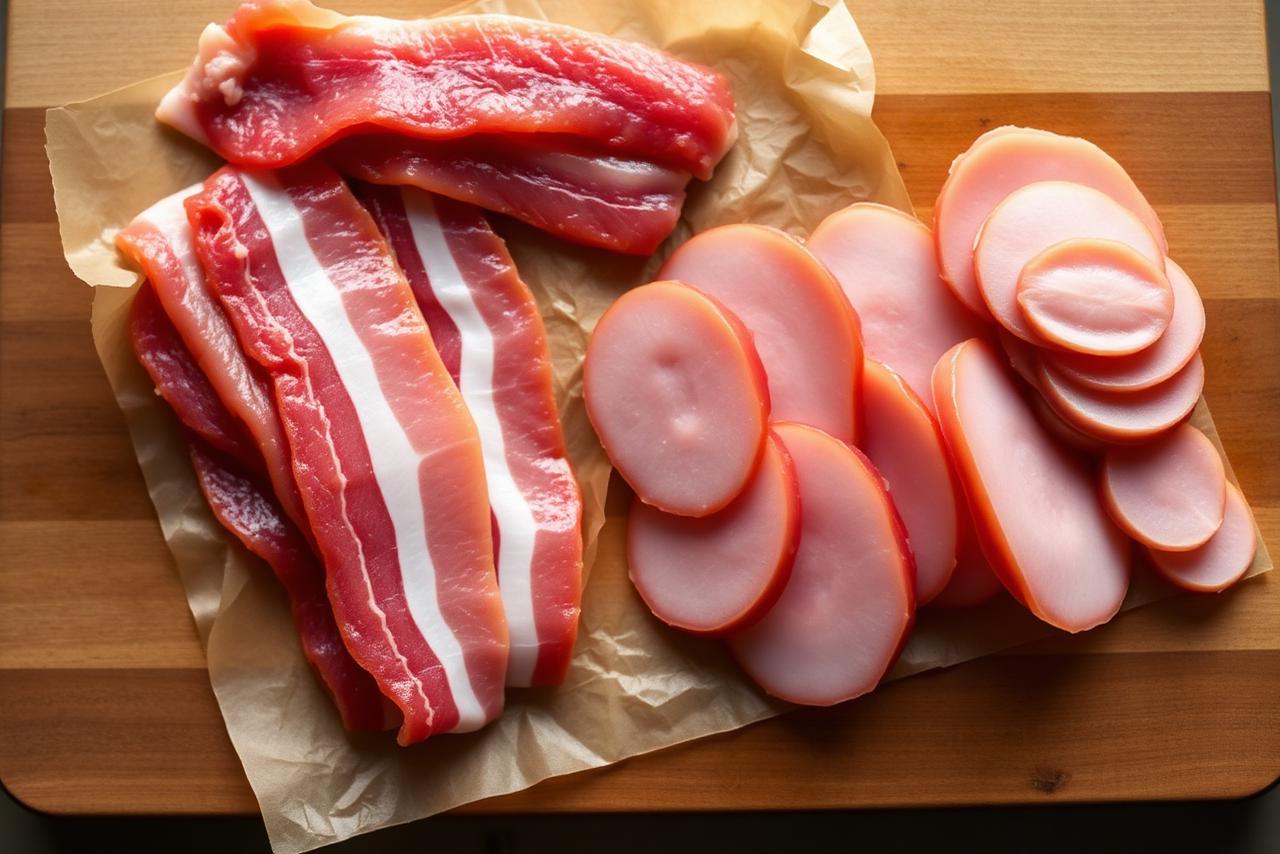
What sodium nitrite and nitrate do
Sodium nitrite (E250) is added to cured meats primarily to prevent the growth of Clostridium botulinum — the bacterium that causes botulism — and to produce the pink colour and characteristic flavour of bacon, ham, and salami. Sodium nitrate (E251) acts as a slow-release reservoir, converting to nitrite over time in dry-cured products such as prosciutto and salami.
The technical function is real and important: modern bacon and ham without curing salts would be at meaningful risk of botulism spore germination during storage. The trade-off is that under high-temperature cooking and in the stomach, nitrite reacts with amines in the meat protein to form N-nitroso compounds, some of which are known animal carcinogens.
Regulatory position
- FDA: permitted under 21 CFR 172.170 at maximum 200 ppm in curing brine, with ascorbate/erythorbate co-addition to reduce nitrosamine formation.
- EFSA: 2017 re-evaluation; ADI 0.07 mg/kg body weight per day for nitrite. EU banned nitrites in organic processed meat effective 2024 (Regulation 2023/2108).
- JECFA: ADI 0.06 mg/kg for nitrite, 3.7 mg/kg for nitrate.
- IARC: processed meat classified Group 1 (2015). Ingested nitrate and nitrite under conditions that result in endogenous nitrosation classified Group 2A (2006).
The IARC 2015 classification
In October 2015 the IARC monograph 114 classified processed meat as Group 1 — carcinogenic to humans — based on sufficient evidence for colorectal cancer. The classification is about the strength of causal evidence, not the size of the risk. The estimated dose–response is roughly an 18% increase in colorectal cancer risk per 50 g of processed meat consumed per day (equivalent to about two slices of bacon or one hot dog).
Red meat (unprocessed) was classified Group 2A — probably carcinogenic — in the same monograph, based on more limited evidence.
"Uncured" and "no nitrites added" claims
Products labelled "uncured" or "no nitrites added" in the US typically use celery powder or sea salt fermented with a nitrate-reducing starter culture. Chemically, the nitrite ends up in the finished product just as it would from added sodium nitrite. Independent analyses (e.g. Sindelar 2011) have found broadly similar nitrite residues in "uncured" and conventionally cured products. The FDA requires a "no nitrates or nitrites added except those naturally occurring in celery powder" disclosure, but the marketing framing often overshadows the chemistry.
How NakedCalorie flags nitrite and nitrate
Sodium nitrite and sodium nitrate are Tier 1 additives (highest surfaced severity) with the IARC Group 1 processed-meat classification linked inline. Presence in a product classes it NOVA Group 4 and triggers a "processed meat" warning on scans. See ultra-processed foods for the wider category context.
Frequently asked questions
- Is bacon really carcinogenic?
- The IARC classified processed meat as Group 1 — carcinogenic to humans — in October 2015, based on sufficient evidence for colorectal cancer. That means the evidence for causation is on the same certainty level as tobacco smoking, not the same magnitude of risk. The Group 1 label is about how confident we are in the mechanism, not how big the effect is.
- How much risk is that?
- The IARC monograph estimated an 18% increase in colorectal cancer risk per 50 g of processed meat consumed daily. In absolute terms, a lifetime risk of colorectal cancer of roughly 5% rises to roughly 6% with a daily bacon habit. That is a real risk, but a very different scale from the ~24-fold increase in lung cancer risk from smoking.
- Are 'uncured' or 'no nitrites added' products safer?
- Usually not meaningfully. 'Uncured' products almost always use celery powder or sea salt with cultured starters, which are chemically the same nitrite and nitrate — just derived from a plant source. The final nitrite level in the product is often similar. This is one of the more misleading label claims in the meat aisle.
Written by NakedCalorie editorial team.
Medically reviewed by Pending registered dietitian review — last reviewed July 15, 2026.
Educational information only, based on peer-reviewed literature and regulatory sources. Not medical advice.
Related in the knowledge base
- AdditivesSulfites (sulphur dioxide and related compounds)
- AdditivesPotassium sorbate
- AdditivesSodium benzoate